Activities & Things to do in Nepal
Nepal is one of those rare countries that genuinely surprises every type of traveller. Mountaineers come for the eight 8,000-metre peaks and stay for the culture. Cultural tourists come for the ancient temples of the Kathmandu Valley and stay for the mountains. Wildlife enthusiasts come for the Bengal tigers of Chitwan and stay for the spiritual atmosphere of Lumbini. Adventure seekers come for the rafting and paragliding and stay for the community homestays and the cooking classes and the silence on a high ridge at dawn. Whatever reason brings someone to Nepal, the country almost always delivers something beyond it.
This guide covers the full range of things to do in Nepal across every major region, interest type, and budget level. It is not a list of sights. It is a practical, honest account of experiences that are actually worth having — what they involve, why they matter, and what makes them uniquely Nepal rather than something you could find anywhere else. Read it from beginning to end or jump to the section that matches what you came for. Either way, by the end, you will know what to put on the itinerary.
Nepal rises from dense jungle to the highest mountains on earth in under 200 kilometers. Very few countries on earth ask so little of you in exchange for so much.
Trekking in the Himalaya
Trekking is Nepal’s defining activity and the experience that most visitors come for. The trail system is one of the finest in the world: centuries-old footpaths linking mountain villages, glacier viewpoints, and ancient monasteries across two of Asia’s greatest mountain ranges. You do not need to be a mountaineer. You do not need prior trekking experience. You need decent fitness, the right footwear, a licensed guide (mandatory for foreign nationals from 2025), and a willingness to walk uphill.
Poon Hill and the Annapurna Foothills
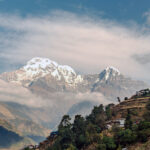
The Poon Hill circuit from Nayapul is Nepal’s most popular short trek and the best entry point for first-time trekkers. The trail climbs through the Gurung village of Ulleri via 3,000 stone steps, continues through rhododendron and oak forest to Ghorepani at 2,860 metres, and then rises to the pre-dawn summit of Poon Hill at 3,210 metres. The panoramic arc of Dhaulagiri (8,167 m), Annapurna I (8,091 m), Annapurna South, Hiunchuli, Nilgiri, and Machhapuchhre illuminated by the first sun is the most celebrated mountain sunrise viewpoint in Nepal. In March and April the surrounding forests are carpeted with rhododendron bloom in red, pink, and white. The circuit takes four to five days and requires no technical experience.
Beyond Poon Hill, the Annapurna region offers the Ghandruk circuit (easier, more culturally rich, ideal for families), the Mardi Himal trek (quieter, more dramatic, closer to Machhapuchhre’s unclimbed south face), the Khopra Ridge (reaching 3,660 metres with an optional sacred lake hike), and the full Annapurna Circuit — a 15 to 20-day journey circumnavigating the entire Annapurna massif through the world’s deepest river gorge and over the Thorong La pass at 5,416 metres.
The Everest Region
The Khumbu valley is the most celebrated trekking destination on earth. The trail from Lukla airport (reached by a 35-minute flight from Kathmandu) follows the Dudh Koshi River north through the Sagarmatha National Park, crossing the famous Hillary Suspension Bridge before climbing to Namche Bazaar at 3,440 metres — the Sherpa capital of the Khumbu and the most important mountain trading town in the Himalaya.
From Namche the trail continues to Tengboche Monastery at 3,870 metres, where Everest, Lhotse, Nuptse, and Ama Dablam are visible simultaneously from the monastery courtyard. Further still, Gorak Shep and the Khumbu Glacier at 5,160 metres lead to Kala Patthar at 5,545 metres, the closest trekking summit to Everest accessible without technical climbing. The view from Kala Patthar — Everest, the Khumbu Icefall, the South Col, and the upper ridges of Lhotse and Nuptse filling the southern sky — is simply the finest mountain view in the world. The standard Everest Base Camp trek takes 12 to 14 days. Shorter options include the Namche Bazaar trek (7 to 8 days) and the Everest View Trek (7 days, reaching 3,880 metres at Hotel Everest View).
Lesser-Known Trekking Regions
Nepal has six other major trekking regions beyond Annapurna and the Khumbu, each with its own character and appeal.
- Langtang Valley is the closest major trekking region to Kathmandu, requiring no domestic flight. The valley ascent to Kyanjin Gompa at 3,870 metres passes through Tamang Buddhist villages and reaches the base of Langtang Lirung (7,227 m). The acclimatisation hike to Kyanjin Ri at 4,773 metres gives one of the finest 360-degree panoramas in the country.
- Manaslu Circuit is an 18 to 20-day circuit around the world’s eighth highest peak (8,163 m), through restricted area requiring a special permit. One of Nepal’s finest and most varied long treks, passing through Gurung and Tibetan Buddhist communities with views of Manaslu, Ganesh Himal, and the Annapurna range.
- Upper Mustang is the ancient Tibetan kingdom north of the Annapurna-Dhaulagiri massif, in a restricted area accessible by permit. The landscape is desert plateau, cave monasteries, and medieval walled cities rising from an arid river canyon. Lo Manthang, the walled capital, has been continuously inhabited for over 700 years.
- Kanchenjunga Circuit is the most remote major trek in Nepal, reaching both the North Base Camp at Pangpema (5,143 m) and the South Base Camp at Oktang (4,730 m) of the world’s third highest peak. An extraordinary two to three-week journey for experienced trekkers.
- Dolpo and the Crystal Mountain region in western Nepal is one of Asia’s most remote and culturally preserved Himalayan landscapes. The hidden valley of Shey Gompa, the sacred Crystal Mountain, and the traditional Bon Buddhist communities of the upper Dolpo make this one of the world’s great long-distance wilderness journeys.
- Mohare Danda in the Annapurna foothills is one of Nepal’s finest off-the-beaten-path short treks, reaching a 3,300-metre ridge viewpoint with a 270-degree Himalayan panorama and community lodges run by traditional Magar farming families.
Exploring Nepal’s Ancient Culture and Heritage
Nepal’s cultural heritage is as extraordinary as its natural landscape. The Kathmandu Valley alone holds seven UNESCO World Heritage Sites within a 20-kilometre radius — a concentration of sacred architecture, living tradition, and artistic achievement that has no parallel anywhere in Asia. But Nepal’s cultural depth extends well beyond the capital, from the birthplace of the Buddha in the southern plains to the medieval city-states of the valley rim to the Tibetan Buddhist monasteries of the high mountain corridors.
Kathmandu’s Sacred Sites
Pashupatinath Temple on the Bagmati River is Nepal’s most sacred Hindu site and one of the most important Shaivite temples in the world. The extensive temple complex on the river’s western bank houses the main shrine (accessible to Hindus only) and the wide cremation ghats on the riverbank below. The evening aarti ceremony performed by priests as the sun sets over the river, with butter lamps lit along the Arya Ghat and the sound of devotional music rising into the dusk, is one of the most powerful and moving experiences available to any traveller anywhere in Asia. Arrive by 5:00 PM. Stay through the full ceremony.
Boudhanath Stupa is one of the world’s largest Buddhist monuments, rising 36 metres above the Kathmandu valley and surrounded on all sides by Tibetan monasteries, meditation centres, and the perpetual sound of prayer wheels turning. The stupa dates from the 5th century CE and is the global centre of Tibetan Buddhist practice outside Tibet. The pre-dawn circumambulation walk at 5:30 AM, when monks chant from the monastery windows above and butter lamps burn along the plinth, is Kathmandu’s single finest morning experience.
Swayambhunath, the hilltop stupa known as the Monkey Temple, dates from the same era and sits atop a forested hill with sweeping views of the Kathmandu Valley. The 365-step staircase passes through the resident rhesus monkey colony. From the summit platform the watching eyes of the Buddha on the gilded spire look in four directions. Best at sunrise.
Bhaktapur and Patan — The Medieval Cities
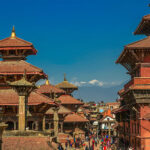
Bhaktapur, 13 kilometres east of Kathmandu, is Nepal’s finest preserved medieval city. The Nyatapola Temple (built 1702, Nepal’s tallest pagoda at five tiers), the Golden Gate, the 55-Window Palace, and the Pottery Square where wheel-thrown earthenware has been made continuously for centuries create one of Asia’s most remarkable living heritage landscapes. A full day is required to walk it properly. The locally made yoghurt (juju dhau) served in traditional clay pots is one of Nepal’s most distinctive food experiences.
Patan, directly south of Kathmandu across the Bagmati River, holds the finest Newari temple architecture in the valley alongside the internationally acclaimed Patan Museum, one of Asia’s outstanding collections of Buddhist and Hindu metalwork. The surrounding neighbourhood of Mangal Bazaar, with its stone-paved lanes and working craftsmen’s workshops, is one of the most rewarding places in Nepal for slow, curious exploration. Patan is also Nepal’s centre for traditional metalworking, thangka painting, and pashmina weaving.
Lumbini — The Birthplace of the Buddha
Lumbini in the southern Terai is one of the most significant pilgrimage destinations in the Buddhist world: the verified birthplace of Siddhartha Gautama, who became the historical Buddha in the 5th century BCE. The UNESCO World Heritage Site is centred on the Maya Devi Temple and the sacred Puskarini pond, where the Buddha’s mother bathed before giving birth. An Ashoka Pillar erected in 249 BCE marks the exact birth spot, making it one of the oldest verified historical monuments in Asia. Surrounding the sacred garden, over 30 nations have built monasteries in their own architectural traditions, creating a remarkable international monastic zone.
The ruins of Tilaurakot, 27 kilometres west of Lumbini, are believed to be the ancient city of Kapilavastu where the historical Buddha spent his first 29 years before renouncing royal life. Largely unvisited by international tourists and carrying an extraordinary sense of history, Tilaurakot is one of Nepal’s most rewarding heritage sites for those who seek depth over crowds.
Changu Narayan and the Valley’s Hidden Heritage
Changu Narayan is the oldest temple in the Kathmandu Valley, built in the 4th century CE and the first UNESCO World Heritage Site inscribed in Nepal. It sits on a forested hilltop in the eastern valley with some of the finest Lichchhavi-period stone and wood carvings in the country. Because it sits away from the main tourist circuit, visitors typically have its extraordinary courtyards and carving galleries largely to themselves.
The sacred site of Pharping in the southern valley holds the Guru Rinpoche meditation caves used by Tibetan Buddhist practitioners since the 8th century CE. The Vajra Yogini shrine adjacent to the caves is one of the valley’s most powerful Tantric pilgrimage sites. Namobuddha Monastery on the eastern valley rim marks one of Tibetan Buddhism’s most revered sacred locations. The medieval Newari river town of Panauti at the confluence of two sacred rivers holds the finest 13th-century temple architecture outside the main valley sites. All four destinations are within two hours of Kathmandu and almost entirely missed by standard tourist itineraries.
Wildlife Safaris and National Parks
Nepal protects nearly a quarter of its total land area in national parks, conservation areas, and wildlife reserves. The results of this commitment are extraordinary: endangered species that have been hunted almost to extinction elsewhere in South Asia survive in Nepal in growing populations. The one-horned rhinoceros, the Bengal tiger, the Gangetic river dolphin, the snow leopard, the red panda, and the Asiatic elephant all have significant populations in Nepal’s protected areas.
Chitwan National Park
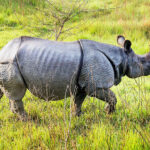
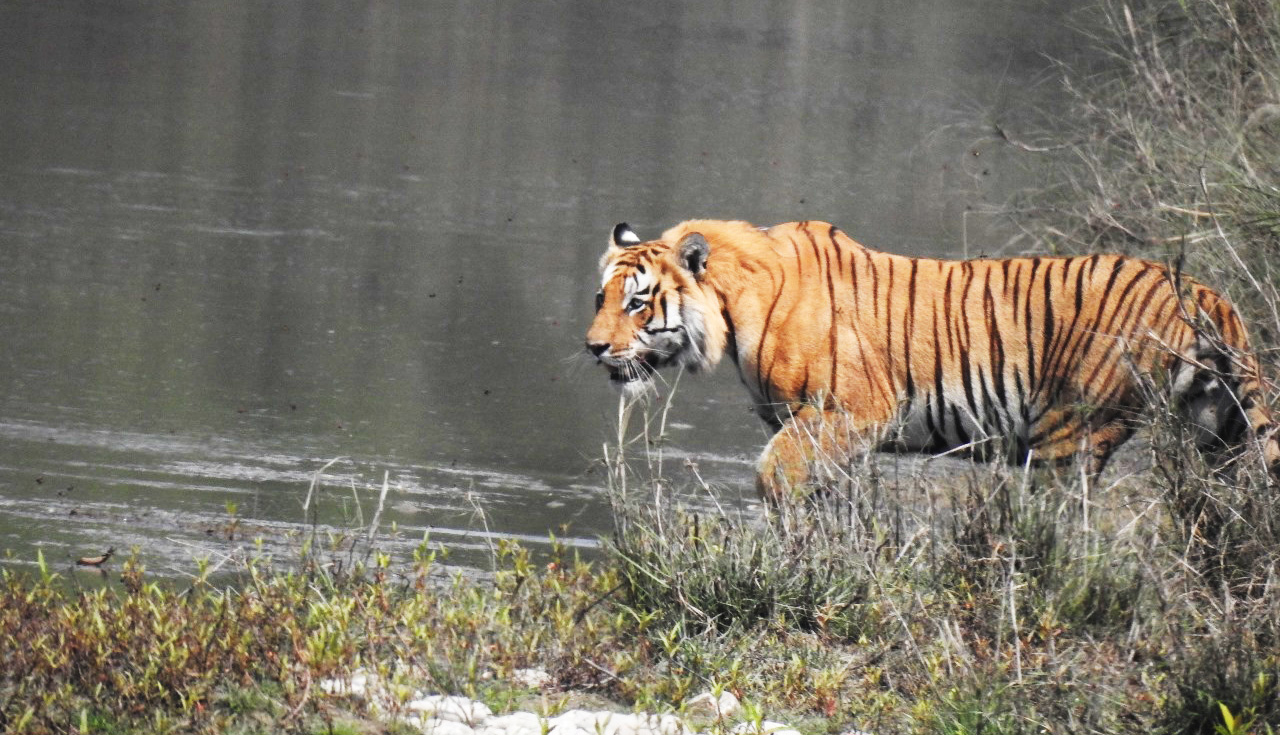
Chitwan is Nepal’s most visited national park and one of Asia’s finest wildlife destinations. The UNESCO World Heritage Site covers 932 square kilometres of subtropical grassland, riverine forest, and sal jungle in the Terai lowlands, and supports one of the world’s highest densities of large mammals. One-horned rhinoceros sightings on morning jeep safaris are virtually guaranteed. The Bengal tiger population has grown significantly in recent years and tiger sightings occur regularly, particularly in the dry season from October to April when water sources in the park dry up and animals concentrate near rivers.
The finest Chitwan experiences are the 6:00 AM jeep safari into the park interior, the pre-dawn canoe ride on the Rapti River (when gharial crocodiles bask on the sandy banks and the light falls golden through the morning mist), the guided nature walk through the buffer zone forest, and the evening Tharu cultural programme in the community lodges outside the park. The Tharu are the indigenous people of the Terai, and their stick dance, dhol drumming, and community storytelling are a genuine and engaging encounter with a culture that has co-existed with this jungle landscape for centuries.
Bardia National Park
Bardia in western Nepal is, in the opinion of many serious wildlife travellers, Nepal’s finest national park. It is larger than Chitwan at 968 square kilometres, receives a fraction of the visitor numbers, and delivers wildlife encounters that feel genuinely wild rather than managed. The Bengal tiger population of over 125 individuals is one of the healthiest in Asia. The Karnali River flowing through the park’s western boundary is one of the last remaining habitats of the endangered Gangetic river dolphin (Platanista gangetica), and a canoe trip on the Karnali for dolphin spotting is a genuinely rare wildlife privilege.
The logistics of reaching Bardia involve a one-hour flight from Kathmandu to Nepalgunj followed by a 1.5-hour road transfer, but the reward is a wildlife experience that most visitors describe as far more intimate and powerful than Chitwan. Tharu community interactions around Bardia are also less commercialised than those near Chitwan, providing a more authentic cultural encounter alongside the wildlife activities.
Snow Leopard Country — the High Himalaya
Nepal’s high-altitude protected areas — Langtang National Park, Sagarmatha National Park, Kangchenjunga Conservation Area, and the Annapurna Conservation Area — provide habitat for the snow leopard, the red panda, the Himalayan tahr, the blue sheep (bharal), and over 850 species of bird. Snow leopard sightings are rare but documented on the trekking trails through the upper Langtang and Mustang valleys. Red pandas are resident in the rhododendron forests of the Annapurna and Langtang regions and occasionally visible on the trails between 2,500 and 4,000 metres. The birding opportunities across all of Nepal’s altitudinal zones are extraordinary — the country holds more bird species per unit area than almost anywhere on earth, including the vibrant Himalayan monal pheasant, Nepal’s national bird.
Adventure Activities in Nepal
Nepal’s geography makes it one of the world’s finest adventure sport destinations. The rivers that fall from the Himalayan glaciers to the Terai plains in less than 200 kilometres are among the most powerful and varied white-water rivers on earth. The thermals over the Pokhara valley are among the most consistent in Asia for paragliding. The bungee platforms above the Bhotekoshi gorge are among the highest in the world. Mountain biking trails descend from 2,000-metre ridges to the valley floor. And the mountain flying experience from Kathmandu domestic airport is in a category of its own.
White-Water Rafting and Kayaking
Nepal’s rivers offer white-water experiences from beginner level to expert, across timeframes from a half-day session to a twelve-day multi-river expedition.
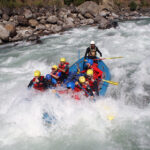
- Trishuli River: Nepal’s most accessible rafting destination, running parallel to the Prithvi Highway between Kathmandu and Pokhara. Class 2 to 3 rapids, suitable for all ages and beginners. A half-day session can be added to any Kathmandu-to-Pokhara road transfer without a detour. One of Nepal’s best value adventure activities.
- Bhotekoshi River: The most technically demanding readily available river in Nepal, with Class 4 to 5 rapids through a narrow gorge below the Tibetan border. Available as a day trip from Kathmandu or combined with the Kalinchowk adventure circuit. Rated by National Geographic as one of the finest day-rafting experiences in Asia.
- Sun Kosi River: One of Asia’s great multi-day river journeys. The eight to ten-day full run covers the river from its Tibetan-border source to the Sapt Kosi confluence, with Class 3 to 5 rapids through remote gorge scenery and camping on sandy beaches each evening. One of Nepal’s finest wilderness adventure experiences.
- Kali Gandaki River: The world’s deepest gorge between Dhaulagiri and Annapurna, with Class 3 to 4 rapids through four ecological zones from the high Mustang plateau to the Terai plains. An outstanding three to five-day multi-day rafting experience, best in October and November.
- Karnali River: The longest river in Nepal, with the finest single-day Class 5 rapid experience in the country at the Royal Flush section. Multi-day expeditions on the Karnali are the most remote and scenically magnificent river journeys available in Nepal.
Paragliding in Pokhara
Pokhara is consistently rated among the world’s top five paragliding destinations. The combination of consistent thermals rising off the Annapurna foothills, the Phewa Lake landing zone, and the unobstructed mountain panorama from the Sarangkot launch site creates conditions that no artificial infrastructure can replicate. Tandem flights with qualified instructors launch from Sarangkot at 1,590 metres and thermal currents carry pilots to 1,800 metres above the valley with the full Annapurna range — Dhaulagiri, Annapurna I, II, III, IV, Annapurna South, Machhapuchhre — spread across the northern horizon throughout the flight. A standard tandem flight lasts 20 to 60 minutes. The landing zone is the Lakeside area of Pokhara. Cost: USD 80 to USD 120. The best flying window is October to December and March to May.
Bungee Jumping and the Bhotekoshi Gorge
The Last Resort’s bungee jump 160 metres above the Bhotekoshi River is one of the world’s most dramatic bungee installations. A single-span bridge over a forested gorge near the Tibetan border provides the launch point. The jump includes four seconds of free fall followed by a 160-metre swing above the white-water river below. It is one of the longest bungee jumps in Asia and sits in scenery that is as spectacular as the jump itself. The same gorge also offers a canyon swing (attached by harness rather than ankles, and covering a wider arc), canyoneering through the gorge walls, and the Grade 4 to 5 Bhotekoshi River rafting. Located four hours from Kathmandu on the Arniko Highway, it can be reached as a day trip.
Mountain Biking
Nepal’s terrain is extraordinary for mountain biking, with the Kathmandu Valley rim, the Annapurna foothills, and the high mountain trails all offering routes that range from accessible to highly technical. The Nagarkot to Banepa descent from the valley rim is one of the most enjoyable downhill mountain bike runs accessible from Kathmandu, combining forested trail riding with valley views and minimal vehicle traffic. The Pokhara valley offers ridge rides above the lake with Annapurna views. The lower Mustang corridor provides a more demanding multi-day mountain biking option through desert canyon scenery at altitude. Several specialist operators in Kathmandu and Pokhara run guided mountain bike tours with quality bicycles and mechanically trained guides.
The Everest Scenic Flight and Helicopter Experiences
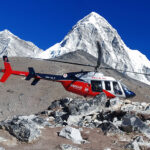
The one-hour panoramic mountain flight from Kathmandu’s domestic terminal is one of Nepal’s most remarkable experiences for its combination of accessibility and spectacle. The aircraft flies at 6,700 metres altitude within close viewing distance of Everest, Lhotse, Makalu, Cho Oyu, and Kanchenjunga. Every passenger receives a window seat. The flight departs at dawn for the best visibility and costs USD 180 to USD 220 per person. For those with a larger budget, private helicopter charters to Everest Base Camp include a landing at Gorak Shep at 5,364 metres with Everest, the Khumbu Glacier, and the South Col directly overhead. The helicopter return from Namche Bazaar via Base Camp on the heli-trek itinerary provides the most complete Khumbu experience available in the shortest timeframe.
Pokhara — Nepal’s Lakeside Adventure Capital
Pokhara is Nepal’s second city and one of its most beautiful. At 827 metres on the shore of Phewa Lake, directly beneath the Annapurna massif, the city combines spectacular mountain scenery with a relaxed lakeside atmosphere, world-class adventure activities, and one of the most diverse concentrations of restaurants, cafes, and accommodation in the country. Every Annapurna trek begins and ends here. It is also, independently, one of the finest places in Asia to simply spend time.
Phewa Lake and the Mountain Reflection
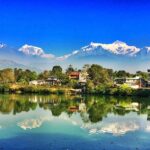
The dawn reflection of Machhapuchhre’s double peak in the still surface of Phewa Lake is one of Nepal’s most consistently beautiful natural moments. Before the wind arrives — usually by 8:00 or 9:00 AM — the lake surface is a perfect mirror for the Annapurna range to the north, and the morning light on the mountains cycles through pink, gold, and white in the space of 20 minutes. A wooden rowboat crossing from the lakeside to Tal Barahi temple on the island costs NPR 800 and takes 20 minutes. The temple is an active Hindu shrine reached by hundreds of daily worshippers and perched on a small island with the mountains behind. One of Pokhara’s most quietly rewarding experiences.
Sarangkot Sunrise
Sarangkot at 1,590 metres is the most famous sunrise viewpoint accessible by road in Nepal. The ridge faces north and the full Annapurna range — Dhaulagiri to the west, Annapurna I through IV, Annapurna South, Hiunchuli, and Machhapuchhre directly ahead — catches the first light simultaneously as the sun rises behind the eastern ridges. Arrive before 5:30 AM for a clear position on the ridge. The viewpoint is also the launch site for paragliding and the starting point for the Sarangkot to Dhampus morning walk, a two-hour downhill trail through Gurung villages that is one of the most pleasant short walks in the Pokhara valley.
Begnas Lake
Begnas Lake, 15 kilometres east of Pokhara, is one of the most beautiful and least-visited lakes in the Pokhara region. Smaller and quieter than Phewa, it is surrounded by forested hills and terraced farmland with Annapurna II visible to the north. Kayaking on Begnas Lake in the early morning, when the surface is still and the mountains are reflected in the water, is one of the most peaceful activities available in the Pokhara region. Fishing is practiced from traditional wooden boats by local communities. The lake circuit by bicycle or electric scooter takes about two hours and passes through farmland villages where daily life continues entirely on its own terms.
The World Peace Pagoda
The World Peace Pagoda, built by Japanese Buddhist organisation Nipponzan-Myohoji, stands on a forested hilltop south of Phewa Lake and is reached either by a 20-minute boat crossing from Lakeside followed by a 45-minute forest trail, or by a longer forested walk from the southern edge of the lake. The white stupa with four standing golden Buddhas faces all directions from its hilltop terrace, and the panoramic view of Pokhara, Phewa Lake, and the Annapurna range from the terrace is among the finest in the region. The walk through the forest is quiet and beautiful.
Spiritual Experiences and Wellness in Nepal
Nepal’s spiritual atmosphere is not manufactured for tourism. It is the product of more than two millennia of continuous practice by living communities of Hindu and Buddhist devotees, priests, monks, sadhus, and pilgrims. The country has more temples, monasteries, and sacred sites than any comparable land area in Asia, and the rituals practiced in them — the morning aarti at Pashupatinath, the evening prayers at Boudhanath, the full-moon pilgrimage to Gosaikunda — are entirely genuine. For travellers who want to encounter spirituality rather than observe it, Nepal is one of the world’s most accessible and profound destinations.
Meditation and Mindfulness
Vipassana meditation centres in Nepal offer ten-day silent meditation retreats based on the Theravada Buddhist tradition. The courses are free of charge (students contribute by donation after completing the course) and are held at centres in Kathmandu, Pokhara, Lumbini, and Budhanilkantha throughout the year. The discipline is demanding — ten days of complete silence, ten hours of meditation per day — but is one of the most transformative experiences available to any traveller. Registration is required several weeks in advance and places fill quickly in the October-November peak season.
Kopan Monastery on the northern rim of the Kathmandu Valley offers one-month residential meditation courses in the Tibetan Buddhist Mahayana tradition, as well as shorter one-week introductory courses accessible to beginners with no prior experience. The monastery sits above the valley with views of the Kathmandu skyline and the Himalayan chain, and the course curriculum includes meditation instruction, dharma talks, and guided practice sessions. Namobuddha Monastery on the eastern valley rim offers a quieter and less-visited retreat setting with similar meditation programme options.
Yoga Retreats
Pokhara has the largest concentration of yoga centres in Nepal, with classes ranging from drop-in morning sessions at lakeside studios to week-long residential retreats in the Annapurna foothills. The Himalayan Yoga Academy above Pokhara offers 200-hour and 300-hour yoga teacher training courses accredited by Yoga Alliance International, drawing students from over 40 countries annually. Several retreat centres in the Pokhara hills combine daily yoga practice with silent meditation, Ayurvedic treatments, and guided nature walks.
In Kathmandu, yoga studios cluster around the Boudhanath and Thamel areas with early morning classes that begin at 6:00 AM. Practising yoga at dawn with the sound of the Boudhanath circumambulation walk audible from the studio window is one of Kathmandu’s most genuinely atmospheric daily experiences.
Singing Bowls and Sound Healing
Singing bowl healing sessions are available throughout Kathmandu and Pokhara, typically in centres clustered around Boudhanath, the Thamel neighbourhood, and the Pokhara Lakeside area. The practice uses traditional metal bowls struck or rimmed to produce sustained resonant tones, applied around and on the body in a session lasting 45 to 90 minutes. The bowls are Nepali in origin, not Tibetan as commonly stated — they have been produced in the Kathmandu Valley for centuries by Newar metalworkers. A professional session costs USD 15 to USD 50 depending on the centre and duration.
The Gosaikunda Pilgrimage
Gosaikunda Lake at 4,380 metres in the Laurebina massif is one of the most sacred sites in the Hindu-Buddhist world. The lake is believed to have been created by Lord Shiva’s trident and draws hundreds of thousands of Hindu pilgrims during the Janai Purnima full moon festival in August. At other times of year the approach through Langtang National Park is quiet, the lake is serene, and the dawn reflection of the surrounding peaks in the high-altitude water carries a spiritual atmosphere that exceeds most purely natural landscape experiences. The three-day trek from Dhunche to the lake via Sing Gompa is accessible to any reasonably fit traveller with appropriate acclimatisation.
Food, Festivals, and Cultural Encounters
Nepali Food and Cooking Experiences
Nepali cuisine is built around the dal bhat tarkari — lentil soup, steamed rice, and vegetable curry — that forms the foundation of daily meals across every altitude and every ethnic community from the Terai plains to the high mountain valleys. It is nutritious, well-seasoned, and endlessly varied by region: Newari cuisine in the Kathmandu Valley is rich with fermented vegetables, buffalo meat, beaten rice, and mustard oil. Thakali cuisine from the Mustang region uses local buckwheat, barley, and the distinctive Timur pepper. Sherpa cuisine in the Khumbu is potato-based, warming, and fortified with yak butter tea and chang (barley beer) on cold nights. Magar and Gurung cooking in the Annapurna foothills emphasises fermented pickles, millet beer (tongba), and smoked meats.
Momos are Nepal’s most popular street food and one of the country’s finest culinary pleasures: steamed or fried dumplings filled with minced buffalo, chicken, or vegetables and served with a tomato and chilli dipping sauce. The best momos in Kathmandu are found in simple local restaurants in the lanes around Boudhanath, in the basement diners of Patan’s Mangal Bazaar, and at the famous Shandaar Momo stall in Basantapur Durbar Square. A plate of ten momos costs NPR 100 to NPR 200 (approximately USD 0.75 to USD 1.50).
Newari cooking classes in Bhaktapur and Patan teach travellers to prepare the traditional dishes that form the cultural foundation of valley cuisine: chiura (beaten rice), bara (black lentil pancakes), aalu tama (bamboo shoot and potato curry), and the full range of pickles and condiments that accompany a traditional Newari feast. A half-day class with a local family costs USD 30 to USD 60 and includes a shared meal.
Nepal’s Festivals
Nepal celebrates more than 50 festivals annually across its Hindu and Buddhist communities, and arriving during a major festival transforms the experience of almost any destination.
- Dashain in October is Nepal’s longest and most important Hindu festival, celebrating the victory of the goddess Durga over evil. For 15 days, the country comes alive with kite flying, bamboo swings in village squares, family gatherings, and the ritual of tika (red vermilion blessing) applied to younger family members by elders. The Kathmandu Durbar Square celebrations and the Hanuman Dhoka palace festival events are particularly spectacular.
- Tihar in October or November (five days following Dashain) is Nepal’s Festival of Lights, honouring crows, dogs, cows, oxen, and brothers and sisters in successive daily ceremonies. Lakeside Pokhara and the Thamel area of Kathmandu are covered in oil lamp rows and coloured powder rangoli patterns that glow in the evening dark.
- Indra Jatra in Kathmandu in September is the old royal festival of the city, celebrated with the living goddess Kumari paraded through the streets on a wooden chariot. The eight-day festival fills Kathmandu Durbar Square with traditional Newari music, masked dances, and processions that have continued in the same form for over a thousand years.
- Janai Purnima in August draws pilgrims from across Nepal to Gosaikunda Lake, the Kumbheshwar Temple in Patan, and Pashupatinath for the sacred thread renewal ceremony. The journey to Gosaikunda during Janai Purnima, alongside thousands of Hindu pilgrims ascending through the Langtang forests, is one of Nepal’s most extraordinary collective human experiences.
- Bisket Jatra in Bhaktapur in April is the Newari New Year festival, centred on the pulling of massive wooden chariots through the streets and the raising of a ceremonial pole in the main square. One of Nepal’s most dramatic and least-touristy major festivals.
Off-the-Beaten-Path Nepal
The most memorable Nepal experiences are often found away from the main trekking routes and heritage sites. These destinations reward travellers who look beyond the standard itinerary.
Bandipur — Nepal’s Finest Hilltop Town
Bandipur sits on a ridge at 1,030 metres midway between Kathmandu and Pokhara, accessible by a 20-minute road ascent from the Prithvi Highway. The town’s vehicle-free main bazaar street is lined with traditional Newari merchant houses with carved wooden windows and colonnaded ground floors, built when Bandipur was a prosperous stop on the India-Tibet trade route. Today it is quiet, unhurried, and one of Nepal’s most perfectly preserved heritage towns. The Tundikhel viewpoint at the northern end of the bazaar delivers a panorama of Annapurna, Manaslu, Himalchuli, and Baudha peak that rivals viewpoints reached only by trekking. Bandipur is an ideal overnight stop between Kathmandu and Pokhara.
Mustang’s Ancient Cave Monasteries
The cliffs of the upper Mustang district contain thousands of man-made caves, many of them dating to the pre-Buddhist period of 2,000 to 10,000 years ago. Excavated in recent decades by international archaeologists, the caves have revealed human remains, murals, manuscripts, and artefacts that rewrite the history of human habitation in the high Himalaya. The Mustang cave complex around Chhoser village and the monastery caves of Luri Gompa are accessible during the Upper Mustang trek for those with the special Restricted Area Permit (USD 500 for ten days). The painted monastery interiors of Lo Manthang, the 700-year-old walled capital of the ancient Mustang kingdom, contain some of the finest surviving examples of Tibetan Buddhist fresco art in the world.
The Newari Villages of Bungamati and Khokana
Bungamati and Khokana lie 8 kilometres south of Patan in the Bagmati Valley and are two of the finest surviving examples of traditional Newari village architecture and community life in Nepal. Bungamati is home to the second temple of Rato Machhendranath, the rain deity worshipped by both Hindus and Buddhists in the valley. The village’s traditional craftsmen produce wood carvings exported across Nepal. Khokana is a mustard-oil pressing village where the traditional stone mills and the working community life of the Khokana central square have changed little in character for centuries. Both villages are accessible by bicycle from Patan in under an hour.
Rara Lake — Nepal’s Hidden Himalayan Jewel
Rara Lake in the remote Mugu district of western Nepal is the country’s largest lake at 10.8 square kilometres and 2,990 metres altitude. Surrounded by alpine forest and the peaks of the Rara National Park, the lake is one of Nepal’s most beautiful and least-visited natural destinations. The water changes colour through the day from deep blue to turquoise to steel-grey depending on the light and the cloud. The surrounding forest is home to Himalayan black bears, musk deer, and the red panda. Reaching Rara requires a domestic flight to Talcha airport followed by a two-day trek — the remoteness is the point. Travellers who make the effort describe the lake and its surrounding landscape as among the finest natural experiences in Asia.
Planning Your Nepal Trip
Best Time to Visit Nepal
Nepal has four distinct seasons and the best time to visit depends entirely on what you plan to do.
- October and November are the finest months for trekking, cultural sightseeing, and wildlife safaris simultaneously. Post-monsoon air is clear, the mountains are freshly snowed, and all major destinations are at their best. October is the single finest month in the Nepal travel calendar.
- March and April deliver the rhododendron bloom across the Annapurna and Langtang regions and are excellent for trekking. Mountain visibility builds through April. Spring is the best season for the Annapurna region specifically.
- December and January are cold at altitude but often crystal clear and uncrowded. Chitwan and Bardia wildlife safaris are at their best in winter. Kathmandu heritage sightseeing is comfortable year-round. Trekking above 3,000 metres requires proper cold-weather preparation.
- June through September is monsoon season. Trekking routes are wet and leech-prone. The rain-shadow regions of Upper Mustang and Lower Mustang are viable during monsoon as the Annapurna-Dhaulagiri massif blocks the rainfall. Chitwan and Bardia operate year-round. Cultural sightseeing in Kathmandu is unaffected by monsoon. The Janai Purnima pilgrimage to Gosaikunda in August is one of Nepal’s most extraordinary human experiences and is specifically a monsoon-season event.
Getting to Nepal
- International flights arrive at Tribhuvan International Airport (KTM) in Kathmandu. Main airline connections: Qatar Airways via Doha (best connection for European travellers), Turkish Airlines via Istanbul, Air India from Delhi and Mumbai (best for travellers from South and Southeast Asia), Emirates via Dubai, and Thai Airways via Bangkok.
- Nepal Tourist Visa on arrival: USD 30 for 15 days, USD 50 for 30 days, USD 125 for 90 days. Bring two passport photos and USD cash. The online e-Visa through nepalimmigration.gov.np is faster and strongly recommended.
- Domestic flights connect Kathmandu to Pokhara (25 minutes), Lukla (35 minutes), Bharatpur for Chitwan (30 minutes), Nepalgunj for Bardia (1 hour), Talcha for Rara (2 hours), and Jomsom for Mustang (20 minutes from Pokhara). Book domestic flights well in advance in October and November.
Practical Information
- Guide requirement: Solo trekking is not permitted for foreign nationals in Nepal from 2025. All trekkers on designated routes must be accompanied by a licensed Nepali guide. A guide costs USD 25 to USD 50 per day and is included in reputable operator packages.
- Currency: Nepali Rupee (NPR). USD 1 is approximately NPR 133 as of 2026. ATMs are available in Kathmandu, Pokhara, and Chitwan. They are absent on trekking trails above the trailheads. Carry sufficient NPR cash before leaving the main towns.
- Budget: Nepal is genuinely affordable. A comfortable mid-range budget of USD 50 to USD 100 per day covers a private hotel room, all meals, a licensed guide, and domestic transport. Budget travellers can manage on USD 25 to USD 40 per day in shared teahouses and local restaurants. Luxury options are available from USD 150 per day upward.
- Safety: Nepal is one of the safest countries in Asia for international travellers. Crime rates are minimal. The main risks are altitude sickness on high-altitude trekking routes (preventable with proper pacing and acclimatisation), road travel on mountain highways, and occasional trail hazards in monsoon season. Comprehensive travel insurance covering trekking, medical treatment, and helicopter evacuation is mandatory for any trekking itinerary.
- Languages: Nepali is the official language. English is widely spoken in Kathmandu, Pokhara, Chitwan, and all major trekking areas. In remote trekking regions, your licensed guide handles all necessary communication.
Why Nepal Stays With You
There is something about Nepal that does not let go. Travellers who come for two weeks often start planning their return before they have left. People who intended a once-in-a-lifetime Everest Base Camp trek come back for Manaslu, then Langtang, then Dolpo. Cultural visitors who spent a week in Kathmandu’s temples arrive the following year for the Mustang cave monasteries. Wildlife enthusiasts who spent two nights in Chitwan return for Bardia. The country reveals itself in layers, and each layer is as extraordinary as the last.
Part of what makes Nepal different is the combination of scale and accessibility. The highest mountains on earth are here. The most sacred Hindu temple in Asia is here. The birthplace of the Buddha is here. The most endangered large mammals in Asia are here. The finest short-duration paragliding in the world is here. And almost all of it is within reach of any reasonably healthy traveller with a week or two of holiday time and a willingness to step outside the resort infrastructure and into the country itself.
The question for most people is not whether Nepal is worth visiting. The question is where to begin. Begin anywhere. The country will take it from there.
Ready to plan your Nepal trip? Talk to a Nepal specialist who has trekked every major route and knows every corner of the country personally. Tailor-made itineraries for every budget, every interest, and every timeframe.
Recent Posts