Things No One Tells You About Traveling in Nepal
Most people arrive in Nepal carrying a version of the country assembled from other people’s photographs. Everest from a distance. Prayer flags on a high pass. A monk in a saffron robe. Dal bhat by candlelight. These images aren’t false — they just represent about four percent of what Nepal actually is. The other ninety-six percent is what gets you.
Nepal is one of those rare places that consistently surprises even experienced travelers — not with manufactured spectacle, but with the quiet, specific, sometimes bewildering details that no guidebook bothers to mention because they’re too mundane, too strange, or too difficult to explain without context. The country operates on its own logic: its own calendar, its own time zone, its own spatial relationship to the concept of distance, and its own deeply embedded hospitality culture that can leave first-time visitors genuinely disoriented in the best possible way.
What follows are the things that people who have actually spent time in Nepal — not photographing it, but living inside it — wish someone had told them before they arrived. Some are practical. Some are cultural. Some are simply true in ways that take a while to process. All of them will change how you experience the country.
1. Nepal Runs on a Different Calendar Entirely — and It Matters More Than You Think
The Bikram Sambat calendar, which Nepal uses officially for government functions, festivals, and daily civic life, runs approximately 56 to 57 years ahead of the Gregorian calendar. As the rest of the world moves through 2026, Nepal’s official year is 2082 to 2083. Nepali New Year falls in mid-April, not January. When a government office posts a deadline or a festival notice lists a date, it’s in Bikram Sambat — a system most international travelers have never encountered and don’t think to check.
This matters practically because Nepal’s major festivals — Dashain, Tihar, Indra Jatra, Losar, Chhath Puja — are calculated on this calendar and don’t fall on fixed Gregorian dates. The year Dashain begins in late September, the next year it shifts to October, the year after to mid-October. If you’re planning a trip specifically to witness one of these festivals — and you should be, because they’re among the most extraordinary public celebrations anywhere in Asia — you need the Bikram Sambat date, not the Western one, to plan accurately.
2. The Country Has 123 Languages — and Nepali Is Not Always the One Being Spoken
Nepal is smaller than California. Within that area, 123 distinct mother tongues are spoken — not dialects or regional accents, but fully distinct languages, many of which have no written form and exist entirely in oral tradition. Nepali functions as the national lingua franca, but in the eastern hills communities speak Rai and Limbu. In the Kathmandu Valley’s old neighborhoods, Newari — officially called Nepal Bhasa — operates as the language of the guthi system, religious rituals, and intergenerational cultural memory. In Mustang, Tibetan dialects prevail. In the Terai, Maithili and Tharu communities communicate in languages that share more with the north Indian plains than with the Nepali highlands.
What this means for travelers is that the country you move through is not culturally homogenous in any meaningful sense. A five-day trek from the Terai to the Khumbu crosses through entirely distinct ethnic worlds. The guide who speaks fluent Nepali may be functionally foreign in a Rai village just as much as you are — and is navigating that unfamiliarity with his own set of assumptions. Nepal rewards travelers who understand this layering. It baffles those who expect a single coherent cultural narrative from Kathmandu to Everest.
3. The Mountains Are Not Always Visible — and That’s Not a Travel Agency’s Fault
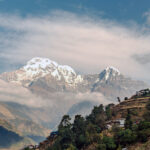
Every first-time visitor to Nepal has some version of the same experience: they arrive in Kathmandu, look north toward where the Himalayas are supposed to be, and see brown haze and the outlines of buildings. The mountains appear to be absent. This is not a myth. Nepal’s major cities sit in valleys, and the combination of topography and pollution means that Himalayan views from Kathmandu are genuinely intermittent — spectacular on clear winter mornings after rain has washed the air, unreliable in the pre-monsoon heat, and essentially nonexistent from the city center during the dry dusty months of February and March.
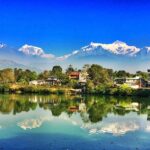
The mountains exist. They are exactly where the maps say they are. But Nepal’s weather is not a performance scheduled for your arrival. Cloud cover builds by 10 or 11 AM in most trekking regions, meaning the pre-dawn departure for any viewpoint is not travel industry theater — it’s the only window. A clear October morning at the Sarangkot viewpoint above Pokhara, with Dhaulagiri to Manaslu spanning the horizon in early light, is among the most visually overwhelming experiences available anywhere on earth. But arriving on a February afternoon and being disappointed because the mountains aren’t visible is a function of expectations, not of Nepal’s failure to deliver.
4. “Nepali Time” Is a Real Concept with Real Consequences
Nepal’s time zone is UTC +5:45 — a 45-minute offset from India that exists specifically to assert temporal independence from its southern neighbor, and one of only three 45-minute time zones in the world. Beyond the technicality, the concept of time in Nepal operates with a flexibility that can frustrate, charm, and occasionally strand travelers who haven’t adjusted their expectations.
A bus departure listed at 7 AM may happen at 7 AM, at 7:30, or when the driver finishes his tea and the conductor has sold enough tickets to justify leaving. A teahouse meal ordered at 6 PM may arrive at 7:15 — not from negligence, but because the kitchen is a single-burner kerosene stove at 3,800 meters and the cook is also the owner, the porter supervisor, the room cleaner, and the person who just had to attend to a guest with altitude symptoms. Domestic flights are cancelled with a frequency that bears no relationship to the original schedule and considerable relationship to cloud ceiling, wind direction, and visibility at mountain airstrips.
None of this is chaos. It’s a different relationship with time in an environment where mountains, weather, and community obligations outrank clocks as organizing principles. Travelers who arrive understanding this spend their Nepal trip relaxed. Travelers who arrive fighting it spend their Nepal trip frustrated with a country that finds their frustration genuinely puzzling.
5. Nepal Is the Birthplace of the Buddha — Not India
This is the single most commonly repeated geographic error in world religion, and Nepalis have been gently correcting it for decades. Siddhartha Gautama, the historical Buddha, was born in approximately 563 BCE in Lumbini — a town in the Terai lowlands of southern Nepal near the Indian border. The Mayadevi Temple at Lumbini marks the precise birth spot, a claim confirmed by the Ashoka Pillar erected by the Indian emperor Ashoka in 249 BCE on his pilgrimage to the site. The inscription on the pillar explicitly identifies Lumbini as the Buddha’s birthplace.
The confusion arises because Buddhism spread outward through India and much of Asia while largely retreating in Nepal itself — today roughly 81% of Nepalis identify as Hindu and around 9% as Buddhist. But the geographic fact is unambiguous: the man who became the Buddha was Nepali by birth. Visiting Lumbini — a UNESCO World Heritage Site that receives a fraction of the visitors that Kathmandu’s heritage sites draw — is one of the most significant and underrated travel experiences Nepal offers. The Maya Devi temple complex, the sacred garden, the monasteries built by Buddhist nations from Japan to Sri Lanka to Myanmar surrounding the central site, and the extraordinary atmosphere of a place genuinely considered the most sacred location in one of the world’s major religions, all sit within a single peaceful complex where the crowds are manageable and the quiet is real.
6. The Kali Gandaki Gorge Is the Deepest Canyon on Earth — and Most Trekkers Walk Through It Without Knowing
Between Annapurna I at 8,091 meters and Dhaulagiri at 8,167 meters, the Kali Gandaki River has been cutting a gorge through the Himalayan rock for millennia. Measured from the summits on either side to the riverbed below, the vertical drop exceeds 5,500 meters — deeper than the Grand Canyon is wide. Trekkers on the Annapurna Circuit walk through the bottom of this canyon for an entire day, passing through the Mustang district’s lower reaches where the gorge narrows to dramatic widths and the cliff walls rise at angles that compress the sky into a narrow strip overhead.
Most of them have no idea. The trail passes through small villages, the river runs beside the path, the walls are impressive but the scale is difficult to process from ground level. A brief geographical orientation from a guide who knows the route reveals what the landscape actually represents: the deepest cut in the earth’s surface, formed by a river that predates the Himalayan range itself and has been actively cutting faster than the mountains rise. That single piece of information transforms a good trekking day into something the trekker spends the rest of the trip thinking about.
7. Nepal Was Never Colonized — and That Fact Runs Deep in the Culture
In a region where British, French, Dutch, and Portuguese colonial powers absorbed virtually every territory they encountered, Nepal remained sovereign throughout the colonial era. The Anglo-Nepalese War of 1814 to 1816 ended not in conquest but in the Treaty of Sugauli — a compromise that ceded border territory but preserved Nepali independence. The British, impressed by the fighting quality of Nepali soldiers to the point of reorientation, responded by recruiting them into what became the Gurkha regiments — one of the most celebrated military units in history, still serving in the British and Indian armies today.
The consequence of this uncolonized history is a culture that never had its social structures dismantled and rebuilt around a colonial administration’s convenience. The guthi system — Newari community self-governance structures that predate modern Nepal by over a thousand years — still functions in Kathmandu, Patan, and Bhaktapur. Traditional land tenure systems, ethnic community structures, religious practices, and linguistic traditions survived intact in ways they didn’t in colonized countries. This is partly why Nepal feels so distinctly itself rather than like a version of somewhere else. It was never forced to become anything other than what it was.
8. The Food Situation Is More Interesting Than Dal Bhat — But Dal Bhat Is Genuinely Extraordinary
Every article about Nepal food leads with dal bhat and stops approximately there. Dal bhat — lentil soup served with rice, vegetable curry, pickle, and various sides — is not a simplified traveler’s meal designed for foreign palates. It’s the result of thousands of years of nutritional optimization for a population doing physically demanding work at altitude, and the Nepali guide’s saying “dal bhat power, 24 hour” is not marketing language. It’s a functional description. Porters carrying 30-kilogram loads to 5,000 meters are eating dal bhat twice a day because the combination of complex carbohydrates, protein, and micronutrients in the traditional full spread genuinely sustains extreme physical output in ways that western protein bars do not.
Beyond dal bhat, the food landscape that most visitors never reach includes: Newari cuisine — one of the most sophisticated traditional food cultures in South Asia, built around fermented, preserved, and slow-cooked techniques developed over centuries in the Kathmandu Valley. Thakali food from the Mustang region — a distinct high-altitude cuisine using buckwheat, barley, local herbs, and Himalayan ingredients unavailable in the valley. Sekuwa — wood-fire grilled buffalo or pork marinated in timur pepper and dried spices, served at roadside stands between Kathmandu and the Terai. Dhido — a buckwheat or millet paste, technically the original Himalayan staple before rice displaced it from the cultural center, still eaten in hill communities and available in some Kathmandu restaurants if you know to ask.
The food traveler who spends a week in Nepal eating momos and pizza in Thamel has missed a genuine culinary world. The one who eats at a Newari community restaurant in Kirtipur, stops at a highway dhaba for sekuwa, and orders dhido in a hill teahouse has experienced something that connects directly to the way Nepal’s diverse geography shaped distinct food cultures across radically different elevations.
9. Hospitality Here Is Not a Tourism Industry Product — It’s a Social Obligation
In Nepali culture, the word “atithi” — guest — carries a weight that the English word doesn’t fully convey. The Sanskrit principle “atithi devo bhava” — the guest is god — is not a hotel marketing slogan in Nepal. It’s a functional social value that shapes how hosts behave in ways that consistently disorient visitors who have calibrated their expectations to transactional tourism culture.
A Nepali family hosting guests will routinely serve every dish available in the house before feeding themselves — the guest eats first, completely, and often finds themselves eating alone while the family watches, refills, and waits. Refusing a second helping requires specific social management — a gentle hand over the plate and a direct “pugyo” (enough) is more effective than a vague “I’m fine.” Being offered tea in a private home is not optional in any meaningful social sense: declining it creates discomfort, accepting it creates connection.
On the trails, this translates into teahouse owners who will wake at 3 AM to prepare a packed breakfast for a summit day departure, who will lend equipment to unprepared trekkers without expectation of payment, and who carry the weight of their guests’ wellbeing — including altitude symptoms, lost permits, and changed itineraries — as a personal responsibility rather than a professional inconvenience. This isn’t performed hospitality. It’s cultural infrastructure. Understanding it as such makes the entire Nepal experience different.
10. Domestic Flights Operate on Weather, Not Schedules
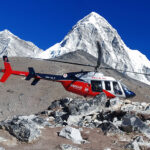
Nepal’s mountain airports are among the most technically demanding airstrips in the world. Lukla’s Tenzing-Hillary Airport, the gateway to the Khumbu and Everest trekking region, has a runway of 527 meters that ends at a rock wall, sits at 2,845 meters, and is entirely dependent on visual flight rules — meaning no instrument-assisted landing in cloud or low visibility. Jomsom airport in the Mustang district closes reliably by 11 AM due to afternoon winds that make the approach corridor unsafe for small aircraft.
The consequence for travelers is that domestic flight schedules in Nepal function as intentions rather than commitments. A flight booked for 7 AM from Kathmandu to Lukla may depart at 7 AM, at 10 AM, or not at all, depending on cloud ceiling at Lukla which may be perfectly clear in Kathmandu. Accumulated weather delays can stack: a single day of bad weather at Lukla creates a backlog of stranded passengers that takes three to four days to clear because the planes are small and the flight window is short.
This is not a flaw in Nepal’s aviation system. It’s the correct response to flying small aircraft in complex mountain terrain where a decision to push through marginal conditions has historically ended badly. The travelers who budget extra days at either end of mountain airport connections — particularly Lukla, Jomsom, Tumlingtar, and Bhadrapur — have relaxed, enjoyable experiences. The travelers who book connecting international flights the day after a Lukla departure create their own emergencies.
11. The Social Rules Around Temples and Homes Are Specific — and Worth Understanding Before You Break Them
Nepal’s religious culture is simultaneously open and boundaried in ways that confuse visitors who expect either total access or clear “no entry” signs. The general principle: outdoor spaces, courtyards, and the exterior of temples are almost always accessible to respectful visitors of any religion. The inner sanctums of Hindu temples — specifically the garbhagriha, the innermost chamber housing the main deity — are typically restricted to Hindus, and at major temples like Pashupatinath in Kathmandu, this restriction is enforced.
Shoes come off before entering any temple, any monastery, and in many cases the porch of a private home. Leather items — belts, bags — are sometimes asked to be left outside Hindu temples where leather is considered impure. Clockwise circumambulation of stupas, chortens, and mani walls is a non-negotiable directional convention in Buddhist practice — walking the wrong way is noticed and mildly corrective looks will follow. Touching someone’s head — including a child’s — is deeply inappropriate in Nepal where the head is considered the most sacred part of the body, while passing objects and touching with the left hand is socially awkward for reasons connected to the left hand’s bathroom associations.
None of these conventions are traps. They’re expressions of a living religious culture that has been operating in this landscape for thousands of years, and Nepali people are genuinely gracious about explaining them to visitors who are clearly curious rather than carelessly ignorant. The travelers who learn the basics before arriving move through Nepal’s sacred spaces with a kind of ease and access that others miss entirely.
12. Altitude Sickness Doesn’t Discriminate — Fitness Is Not Protection
This is the single most important practical truth about Nepal trekking that the fitness-obsessed trekker consistently gets wrong. Acute Mountain Sickness (AMS) is not a function of physical condition. A marathon runner ascending to 4,000 meters too quickly is at exactly the same risk as a first-time trekker of any fitness level. The physiology is straightforward: altitude sickness occurs when the body ascends faster than it can produce the additional red blood cells needed to carry oxygen at reduced atmospheric pressure, and the speed of that adaptation is genetically determined, not fitness-determined.
The consequences range from headache, nausea, and sleep disruption at the mild end to High Altitude Cerebral Edema (HACE) and High Altitude Pulmonary Edema (HAPE) — both life-threatening conditions that can develop rapidly above 4,000 meters — at the severe end. The Himalayan Rescue Association’s rule is simple: if symptoms appear, do not ascend. If symptoms include loss of coordination, confusion, or a cough producing frothy pink sputum, descend immediately regardless of time of day or weather.
Acclimatization days built into trekking itineraries exist for precisely this reason. Trekkers who push past them to “save time” are making a medical decision with incomplete information. A good guide monitors oxygen saturation levels with a pulse oximeter at altitude checkpoints — this is not excessive caution; it’s standard practice on any professionally run high-altitude trek, and it’s the mechanism that converts a potentially dangerous situation into an early warning.
13. The Teahouse System Is One of the World’s Great Travel Infrastructures — and It Has Its Own Social Economy
Western travelers arriving in Nepal sometimes express surprise that trekking routes through remote Himalayan terrain — three days walk from the nearest road, at altitudes above 4,000 meters — have guesthouses serving hot food, warm beds, and occasionally WiFi. The teahouse system that makes this possible is not a tourism infrastructure bolt-on. It’s the natural evolution of a hospitality tradition that predates trekking entirely — these communities have been hosting traders, pilgrims, and travelers on trans-Himalayan routes for centuries.
What visitors often don’t understand is the economic structure underneath the comfort. Teahouse accommodation at altitude is often provided at minimal or no cost in exchange for guests eating all meals at the house — a practice that works because the real revenue is in the food and drink markup, which increases with altitude as all supplies must be porter-carried from lower elevations. A hot shower, room charging, and WiFi each carry surcharges. The cost of a cup of tea at 4,500 meters is higher than at 1,500 meters for exactly the same reason that everything at airport restaurants costs more than on the street outside.
Respecting the system means eating at your teahouse if you’re sleeping there, not cooking your own food when a family has carried ingredients up a mountain to feed you, and tipping the cook and porter at the end of the trek as a genuine acknowledgment of the physical labor that makes the experience possible. The tipping conversation happens at the end of every guided trek and is not a formality — it’s a meaningful economic transaction for people whose income is entirely dependent on the short trekking seasons.
14. Nepal’s Wildlife Is Genuinely Extraordinary — and Chitwan Is Not Just “the Jungle Stop”
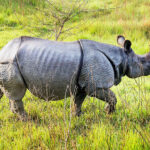
The mental model most trekkers carry about Nepal’s wildlife is rhinos and elephants at Chitwan, experienced on the way to or from a mountain trek. Chitwan National Park does have both — the greater one-horned rhinoceros has made a remarkable conservation recovery in Nepal, with the national population growing from fewer than 100 in the 1960s to over 750 today, almost entirely due to protection within Chitwan and Bardia. But the wildlife picture in Nepal is significantly more complex and surprising than the Chitwan postcard suggests.
The Koshi Tappu Wildlife Reserve in the far east is the most important wetland bird habitat in the entire Himalayan region — over 500 species recorded, including critical populations of waterbirds on the Central Asian Flyway. Bardia National Park in the far west has the highest density of wild tigers in Nepal and far smaller tourist volumes than Chitwan, meaning the quality of wildlife encounter is often significantly better. The Annapurna Conservation Area supports snow leopard populations at high altitude — Shey Phoksundo National Park in Dolpo is considered one of Nepal’s best snow leopard habitats, though sightings require patience measured in days rather than hours. Above the treeline on any Himalayan trek, Himalayan tahr, blue sheep, and the extraordinary Danphe pheasant — Nepal’s national bird, iridescent in the high sun — are reliable sightings for trekkers who move quietly and watch the ridgelines.
15. Having the Right Ground Partner Changes Everything
This is the thing that travelers who’ve been to Nepal will tell you directly, without equivocation, if you ask them what they’d do differently: the experience you have in Nepal is determined more by who is organizing it on the ground than by which trail you choose or which season you travel in. The permit system, the domestic flight timing, the altitude acclimatization schedule, the guide’s knowledge of the specific valley you’re walking through, the teahouse pre-bookings in peak season, the emergency response protocol if something goes wrong at 4,500 meters — all of these things are either handled well or handled badly, and the difference between those two outcomes is the agency you trusted with the details.
Nepal rewards preparation and local knowledge in a way that very few destinations do. A trekker who arrives in Kathmandu and books a guide off a street recommendation in Thamel is gambling with their safety and their experience in a country where the stakes — altitude, remote terrain, complex permit requirements, weather-dependent transport — are genuinely significant. A trekker who works with a registered, professionally operated agency that has TAAN and NTB credentials, certified guides, regional experience, and a 24/7 operational support system has effectively transferred the logistical weight of the entire trip to people who carry it every season.
Getaway Nepal Adventure is that ground partner. Based in Kathmandu’s Thamel district, registered with the Nepal Tourism Board, TAAN, the Nepal Mountaineering Association, and KEEP, the company has been building personalized Nepal itineraries for individual travelers, families, groups, and international travel agency partners for years. The guides are certified, locally rooted, and regionally experienced. The permit handling is in-house. The itinerary design is built around each traveler’s specific objectives, fitness level, and time frame — not repurposed from a standard package. And the support, when something unexpected happens, is real-time and on the ground rather than routed through a call center in another country.
Nepal is generous and surprising and occasionally overwhelming. The single thing that determines whether those qualities work for you or against you is whether someone who knows the country deeply is handling the details that you don’t yet know to ask about. That’s what Getaway Nepal Adventure does. It’s what makes the difference between a Nepal trip that delivers everything this country is capable of and one that delivers the four percent that everyone already knows about.
One Last Thing
Nepal is the only country in the world with a non-rectangular national flag. Two stacked crimson triangles with blue borders, a crescent moon in the upper panel, a sun in the lower — a design representing the Himalayas and the aspiration that Nepal will last as long as the sun and moon endure.
It’s a small fact. But in Nepal, the small facts are often where the real depth lives. The country that fits all of this — 123 languages, eight 8,000-meter peaks, the Buddha’s birthplace, the world’s deepest gorge, an uncolonized history, a 56-year-ahead calendar, a hospitality tradition that predates the modern state — into a strip of land smaller than California is not a place that yields its character quickly.
Give it your full attention. It will give you something back that you will spend years trying to explain to people who haven’t been.
Recent Posts