12 Amazing Things to Do in Chitwan National Park
Nepal’s Himalayas get the postcards. Chitwan gets the memories that don’t fit on a postcard.
Sprawled across 952 square kilometers of subtropical lowland in Nepal’s Terai belt, Chitwan National Park is the country’s oldest and arguably most extraordinary wildlife destination. Established in 1973 and inscribed as a UNESCO World Heritage Site in 1984, it protects 75 species of mammals, 643 species of birds, 55 species of reptiles, and ecosystems ranging from riverine forest to open elephant grassland — all within a natural boundary formed by the Rapti and Narayani rivers. This is the park that brought the one-horned rhinoceros back from the edge of extinction, doubled its wild tiger population in a decade, and continues to run one of Asia’s most significant gharial crocodile conservation programs.
None of that exists behind glass. It’s all out there, on foot, by canoe, and at 5 AM from a wooden tower when the jungle is still deciding what kind of morning it wants to have. Here are the 12 best things to do in Chitwan National Park.
1. Jeep Safari into the Core Zone
Best for: Wildlife spotters, photographers, first-time visitors
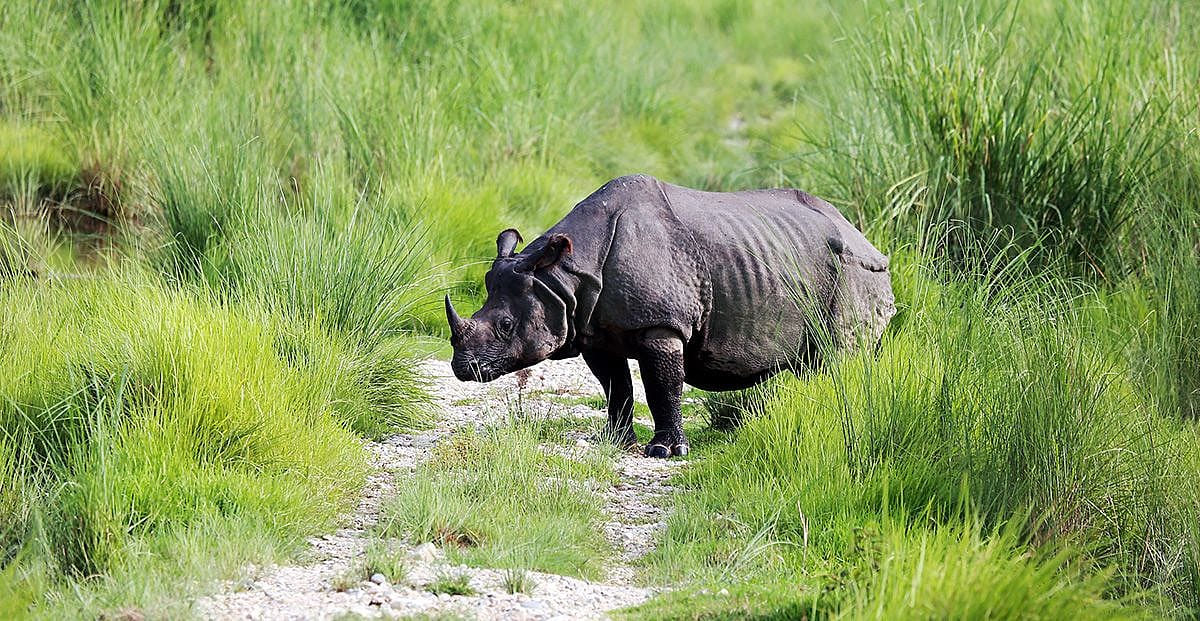
The jeep safari is Chitwan’s workhorse experience, and rightly so. Entering the park’s core zone before dawn in an open 4×4, you move through sal forest, open grassland, and riverside floodplain where rhinos graze in the mist, sloth bears shuffle between termite mounds, and spotted deer scatter from shadows the guide reads before you’ve even noticed them. Book a private jeep over a shared one — the silence between you and the animals matters more than most people realize until they’re sitting twenty meters from a grazing rhino with no engine noise and no crowd.
Insider tip: The January to March window, after grass cutting, delivers the best visibility into the tall elephant grass where tigers rest.
2. Dugout Canoe Ride on the Rapti River
Best for: Wildlife watching from water level, photography, peaceful mornings
There is something deeply specific about floating downriver in a hand-hollowed wooden canoe at six in the morning, with a gharial sunbathing on the sandbank three meters to your left and a pair of great hornbills crossing overhead. The Rapti River is not incidental to Chitwan — it’s the park’s central artery, and the canoe ride puts you inside the riverine ecosystem rather than observing it from the bank. Mugger crocodiles sprawl across sandbanks in implausible numbers. Kingfishers work the shallows. On the best mornings, a tiger at the water’s edge is entirely possible.
Insider tip: Sunrise departures are non-negotiable. The river belongs to its animals before 8 AM.
3. Guided Jungle Walking Safari
Best for: Nature immersion, serious wildlife trackers, those wanting a physical encounter with the forest
Walking through Chitwan is categorically different from riding through it. You hear the warning calls of spotted deer before the rhino appears. You smell the territorial scraping of a tiger on a sal tree trunk before your guide points to it. You understand, viscerally, the scale of the grassland and the density of the forest in a way no vehicle conveys. Experienced naturalist guides read the jungle with fluency — a displaced bird, a crushed grass stalk, a direction of wind — and the walking safari is where that skill becomes genuinely thrilling rather than merely educational.
Insider tip: Wear muted colours and keep conversation minimal. The animals you’re most hoping to see operate on information you can’t always provide quietly.
4. Overnight Tower Stay Inside the Park
Best for: Deep wilderness seekers, photographers, anyone willing to lose a night’s sleep for a lifetime’s story
Chitwan’s jungle towers — raised wooden platforms built in prime wildlife corridors deep inside the park boundary — offer something that no lodge can replicate: a night inside the park itself, unmediated. You sit in darkness, listening to the jungle’s own nocturnal soundtrack: the distant alarm call that means a tiger is moving, the splash of a rhino crossing the shallows, the sawing cough of a leopard in the forest edge. Dawn from a tower, when the mist lifts off the grassland and the first light hits the Churia Hills, is one of Chitwan’s unrepeatable moments.
Insider tip: Book at least two months ahead in peak season. Tower permits are limited and go fast from October onward.
5. Birdwatching — One of Asia’s Finest Sites
Best for: Ornithologists, nature photographers, dawn enthusiasts
With 643 recorded bird species, Chitwan is not merely a good birdwatching destination — it is one of the premier birding sites on the entire Asian continent. The Bengal florican, one of the world’s most endangered bustards, displays its extraordinary flight in the grasslands during breeding season. White-rumped and slender-billed vultures — both critically endangered globally — feed here. Great hornbills, sarus cranes, the giant kingfisher, and thousands of winter migratory species from Central Asia pass through or overwinter in the park’s wetlands and forest edges. The morning boat safari on the Rapti is as much a birding experience as it is a wildlife one.
Insider tip: Bring proper binoculars. The difference between a distant blur and a Bengal florican in full display is 8x magnification.
6. Visit the Gharial Breeding Centre at Kasara
Best for: Conservation-minded travelers, families, anyone interested in species recovery
The Gharial Breeding Centre, established in 1978 at Chitwan’s park headquarters in Kasara, is running one of the world’s most consequential crocodile conservation programs. Gharials — prehistoric-looking fish-eating crocodilians with long, impossibly narrow snouts and a distinctive bulbous nasal growth on males — nearly vanished from South Asian rivers during the 20th century. Since 1981, thousands of hatchlings raised here have been released into the Rapti, Narayani, and Karnali rivers. Seeing 259 of these animals counted in Chitwan’s rivers in the last census — including the extraordinary male gharial in their natural habitat — is witnessing conservation biology in real time.
Insider tip: Ask your guide about the sex-ratio challenge currently facing the gharial population due to temperature-dependent egg incubation. It’s one of conservation’s most complex ongoing puzzles.
7. Tharu Village Walk and Cultural Immersion
Best for: Cultural travelers, anthropology enthusiasts, anyone wanting Nepal beyond wildlife
The Tharu people have lived inside the Terai’s malarial forests for centuries, developing a natural immunity that protected their land from outsiders until the 1950s. Their cultural legacy — mud-plastered houses painted with geometric motifs, bamboo craft traditions, a farming and fishing economy in intimate relationship with the jungle edge — represents one of Nepal’s most distinct indigenous identities. A guided walk through a genuine Tharu village near Sauraha, arranged through a community-based tourism initiative rather than a packaged village tour, connects you with a way of life that has been shaped by this specific landscape for generations.
Insider tip: The Barauli Community Homestay on the park’s western edge is one of Nepal’s best examples of community-managed tourism, where your stay directly benefits Tharu households.
8. Tharu Stick Dance Performance
Best for: Evening cultural experience, families, travelers wanting living tradition not museum culture
The Tharu stick dance is not a tourist performance assembled for hotel courtyards — it’s a martial and celebratory tradition rooted in the community’s warrior history and harvest festivals, performed with a rhythmic precision and physical coordination that takes years to develop. Pairs of dancers in traditional costume beat wooden sticks in interlocking patterns at accelerating tempo, the rhythm building until the performance becomes genuinely hypnotic. Evening shows in Sauraha are usually authentic community presentations rather than staged entertainment, and attending one feels less like watching a cultural exhibit and more like being welcomed briefly into someone’s lived inheritance.
Insider tip: Attend a performance organized by a Tharu cultural organization rather than a resort-branded show — the quality and authenticity differ significantly.
9. Sunrise Canoe to the Rapti-Narayani River Confluence
Best for: Landscape photographers, birding enthusiasts, couples, anyone wanting Chitwan’s most cinematic moment
Where the Rapti River meets the Narayani at Amaltari Ghat, the landscape opens into something genuinely vast — the joined waters stretching toward the Himalayan foothills that appear in the northern distance on clear winter mornings, the riverbanks alive with egrets, cormorants, and storks, the current carrying you through a river intersection where both gharials and Gangetic river dolphins have been recorded. The sunrise light at this confluence is extraordinary, and the scale of the Narayani — one of Nepal’s major river systems — puts everything in a different physical register than the park’s interior forest.
Insider tip: This excursion requires extended canoe time and works best arranged as a full morning with a naturalist guide who knows the bird activity patterns along both rivers.
10. Elephant Breeding Centre Visit
Best for: Elephant welfare advocates, families, wildlife conservation supporters
Chitwan’s Elephant Breeding Centre — located approximately 4 kilometers west of Sauraha — houses working elephants and their young in a program focused on conservation and welfare rather than tourism performance. The facility is best experienced as an observation and education visit: watching mahouts prepare food, observing the social dynamics between calves and adult females, and learning from guides about the role domesticated elephants have historically played in anti-poaching patrols and conservation monitoring. Note that ethical operators no longer offer elephant riding, and any visit should be chosen specifically with welfare-positive operators who do not offer riding as part of their program.
Insider tip: The morning feeding period, when calves interact freely with their mothers before the day’s activities begin, is the most worthwhile time to visit.
11. Night Nature Walk on the Park Buffer Zone Edge
Best for: Adventurous travelers, insect and reptile enthusiasts, those wanting Chitwan’s rarely seen nocturnal world
Chitwan after dark is an entirely different ecosystem from the one that operates in daylight. Specially permitted night nature walks along the park’s buffer zone reveal the forest’s nocturnal residents — Indian flying foxes launching from roost trees in hundreds, Indian civets moving through the undergrowth, nightjars calling from the forest floor, and occasionally the eyeshine of a leopard or sloth bear moving through the darkness beyond the torchlight’s reach. Your guide reads this landscape differently at night, tracking movement by sound and the brief reflections of light in animal eyes.
Insider tip: Wear long sleeves and close-toed shoes. The buffer zone at night is rich in both wildlife and mosquitoes, and insect repellent is not optional.
12. Bicycle Ride Through Tharu Villages and Farmland
Best for: Active travelers, slow tourism advocates, families with older children
The farmland and village network surrounding Chitwan’s buffer zone is one of Nepal’s most underexplored slow travel environments. Renting a bicycle from Sauraha and pedaling through the patchwork of Tharu villages, mustard fields, and riverside farmsteads that exist between the park boundary and the Rapti’s northern bank gives access to a version of Chitwan that jeep safaris and organized tours never reach. You pass farmers heading to fields at dawn, children in school uniforms on the same road, women carrying water, and on the right morning, a wild rhino grazing in a paddy field on the park’s edge as if the boundary between wilderness and civilization is genuinely negotiable — which in Chitwan, it often is.
Insider tip: The western road from Sauraha toward Kasara is the most rewarding cycling route, passing the Rapti riverbank with its resident crocodile population and occasional early morning rhino crossings.
When to Visit Chitwan National Park
October through March is Chitwan’s optimal window. The post-monsoon grass-cutting season (January to February) delivers the best wildlife visibility as the park’s tall elephant grass is reduced to manageable height, exposing animals that would otherwise be completely hidden. Bird diversity peaks in winter when Central Asian migrants arrive. Temperatures are comfortable throughout the day rather than the enervating heat of April through June. The monsoon season (June through September) closes parts of the park due to flooding, though the lush green landscape rewards those who visit in spite of the conditions.
Plan Your Chitwan Trip with Getaway Nepal Adventure
Chitwan National Park rewards depth over speed. A two-night package sees the highlights. Three or four nights reveals the park’s actual character — the morning when a tiger crosses the road twenty meters ahead of you, the afternoon when the gharial at the breeding center surfaces directly beside your canoe, the evening when the Tharu stick dance ends and the crowd disperses into a jungle darkness lit only by cooking fires and stars.
Getaway Nepal Adventure plans Chitwan itineraries as genuinely personalized programs rather than off-the-shelf packages — selecting accommodation based on your specific priorities, arranging naturalist guides with particular expertise in whatever draws you most strongly (tigers, birds, gharials, Tharu culture), and building in the pacing that allows Chitwan to surprise you. As a Kathmandu-based agency registered with the Nepal Tourism Board and TAAN, the company handles permits, transport, and all ground logistics so your time in the park is spent watching the jungle rather than managing its administration. Start planning your Chitwan experience with Getaway Nepal Adventure today.
Recent Posts