What $50 Can Get You in Nepal
Fifty dollars. In most parts of the world, that buys you a mediocre airport sandwich, a taxi from the wrong terminal, and maybe a museum ticket if you’re lucky with the exchange rate. In Nepal, it buys you a full day that you’ll spend the next decade describing at dinner parties with receipts to prove it wasn’t an exaggeration.
Nepal is one of those rare places where the currency conversion math works so dramatically in your favor that it almost feels unethical. At roughly 130 Nepali rupees to the dollar in 2025, your fifty becomes NPR 6,500 — and NPR 6,500 in Nepal is not a budget. It’s a genuinely comfortable daily allowance for a traveler who knows how to spend it. Here’s exactly what that day looks like, broken down hour by hour.
The Morning: Sunrise, Temples, and the Best Breakfast You’ll Eat This Year
The day starts before the city wakes up. A ride-sharing app on your phone Pathao or InDrive, both operating in Kathmandu and Pokhara gets you across town for NPR 100 to 150, roughly one dollar. You’re at Swayambhunath, the hilltop stupa complex the world calls the Monkey Temple, by 6 AM. The entry fee for foreigners is NPR 200 — about a dollar fifty. At this hour, the complex belongs entirely to monks doing their morning circumambulation, pigeons launching from the gilded spire into the early sky, and the smell of butter lamps burning in the small shrines that cluster the hillside. The city spreads below in morning haze. The Himalayas, on a clear October morning, float above it all on the northern horizon.
Come down from Swayambhu by 8 AM and walk ten minutes to one of the small local tea stalls in the surrounding lanes. A glass of chiya Nepali milk tea boiled with ginger, cardamom, and a quantity of sugar that defies cardiovascular advice costs NPR 20. A full breakfast of chiura (pressed rice), fried egg, and vegetable pickle at a local bhatti costs NPR 150 to 200. You have spent approximately three dollars and already had a better morning than most people manage on an entire vacation.
Morning total: approximately $5
The Afternoon: UNESCO Heritage, Living Culture, and Lunch That Costs Less Than a Tip
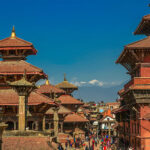
Kathmandu’s Durbar Square is a ten-minute taxi ride from most Thamel hotels. The entry fee for the square — NPR 1,000 for foreigners, about seven dollars and fifty cents — sounds steep against the morning’s prices, but consider what it covers: a medieval royal palace courtyard where Malla dynasty kings were crowned, the Kumari Ghar housing Nepal’s living goddess, temples that predate most European cathedrals, and stone carvings that take professional art historians years to fully understand. Spend two to three hours moving slowly through the square and the surrounding lanes of Indra Chowk and Ason Bazaar, where the old trade routes that once connected Nepal’s interior to Tibet still function as commercial streets.
Lunch is in the old market neighborhood, not in a tourist restaurant. A full plate of dal bhat at a local bhanchha ghar — the no-menu, unlimited-refill rice-and-lentil setup that feeds Kathmandu’s working population every day — costs NPR 250 to 350. This is not a concession to budget travel. Dal bhat at a good local restaurant in the old city is genuinely one of the best meals Nepal offers: fresh mustard greens, slow-cooked black lentils, achar pickles with a heat level that varies by cook, and the communal plate refilled without being asked. You eat until you physically can’t, for roughly two dollars and fifty cents.
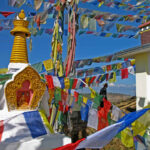
After lunch, walk fifteen minutes northeast to Boudhanath Stupa. Entry is NPR 400. The massive whitewashed dome, one of the largest stupas in the world, sits at the center of a circular plaza lined with Tibetan Buddhist monasteries. Walk the kora clockwise with the monks and the Tibetan exile community who have lived in the surrounding neighborhood for decades. Buy a cup of butter tea from the small stalls in the inner lanes — NPR 50 — and sit with it on the plaza edge while the afternoon light shifts across the golden spire overhead.
Afternoon total: approximately $18 (including entry fees and lunch)
The Evening: A Cooking Class, Street Food, and a City That Knows How to Wind Down
By 4 PM, you have roughly $27 left and the best part of the day still ahead. Many local families and community kitchens in Kathmandu run informal cooking sessions in the late afternoon — two to three hours learning to make momos from scratch, dal bhat from base spices, or Newari chatamari (a savory rice crepe that the Kathmandu food world hasn’t exported anywhere near enough). These sessions typically cost NPR 1,500 to 2,500, which puts a genuine hands-on cooking experience with a local family at twelve to nineteen dollars. You eat everything you make. You leave with recipes that actually work.
If cooking isn’t the evening’s priority, a street food circuit through Asan Bazaar after sunset covers the same ground differently. Sekuwa from a roadside grill — smoky, timur-spiced grilled buffalo — at NPR 200 to 300 per plate. Sel roti, the deep-fried rice doughnut that every Nepali festival runs on, at NPR 30 for two. Momos from a crowded stall in a lane too narrow for two people with backpacks, with tomato-chili sauce that burns in the most clarifying way, at NPR 100 to 150 for a plate of ten.
A cold bottle of local Everest or Gorkha beer at a rooftop bar in Thamel costs NPR 350 to 500. Sit with it above the street, watch the motorcycles thread between the pedestrians six floors below, and run the numbers: a full day in one of the world’s most culturally dense cities — two UNESCO heritage sites, a hilltop temple at sunrise, a living market bazaar, a full sit-down lunch, a cooking class, street food, and a beer above the city — for under $50. The math doesn’t work anywhere else with the same returns.
Evening total: approximately $22
Day total: approximately $45 to $48, with change left over.
The Part That Doesn’t Have a Price Tag
What the budget breakdown can’t quantify is the specific quality of Nepal that makes the money feel almost irrelevant: the consistency with which ordinary moments — a cup of tea with a shopkeeper who has nowhere to be, a monk who stops to explain which direction the prayer wheels should spin, a woman drying rice in a courtyard that has been drying rice for four hundred years — deliver more than the paid experiences that bracket them.
Nepal is, measurably and by any comparative standard, one of the world’s great value travel destinations. But that framing undersells it. It’s not that Nepal is cheap. It’s that Nepal is extraordinarily generous with the things that actually make travel meaningful, and those things happen to be priced in a way that makes them available to nearly everyone.
Make Your Day Count — Book with Getaway Nepal Adventure
Knowing what $50 can get you is one thing. Getting the most out of every dollar — knowing which local bhanchha ghar cooks the best dal bhat in Asan, which time to arrive at Boudhanath for the lighting to be right, which cooking class connects you with an actual family rather than a tourist kitchen — that knowledge lives with people who are from here and work here every day.
Getaway Nepal Adventure is a Kathmandu-based travel company registered with the Nepal Tourism Board, TAAN, and the Nepal Mountaineering Association, building personalized Nepal itineraries for every kind of traveler — solo, family, group, budget-focused, and luxury-minded. The team knows the price of a glass of chiya in Ason and the cost of a helicopter evacuation from the Khumbu, and the entire range in between. Whether your Nepal day runs on $50 or $500, the experience it delivers should be the best version of what that budget makes possible. That’s what Getaway Nepal Adventure builds — reach out and start the conversation.
Recent Posts