The Best Way to See the World’s Highest Mountain
Everest Base Camp Helicopter Tour
There are two ways to reach Everest Base Camp. One takes fourteen days of trekking, careful acclimatisation, and a body that holds up at altitude. The other takes a single morning — and leaves you standing at 5,250 metres with the same view that stops every climber in their tracks.
The Everest Base Camp Helicopter Tour is not the easier option. It is simply a different one. And for a growing number of travellers whether short on time, limited by fitness, or simply wanting to witness the Khumbu up close without a two-week commitment, It has quietly become the most compelling way to experience Nepal’s greatest natural spectacle.
What the Tour Actually Looks Like
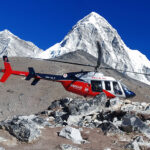
Everything begins before sunrise. A pre-dawn transfer takes you from your Kathmandu hotel to the domestic helipad, where a high-performance Airbus H125 — the helicopter of choice for high-altitude Himalayan operations is already being prepared. Wheels up by around 6:40am.
The flight east follows the ridgeline of the Himalayan chain. Within minutes, the city gives way to terraced hills and river valleys. Peaks appear on the horizon — Manaslu, Ganesh Himal, Langtang — and the scale of what lies ahead begins to register. The helicopter touches down briefly at Lukla’s famous Tenzing-Hillary Airport for refuelling, then pushes north into the Khumbu.
From here the landscape becomes something else entirely. The Dudh Koshi River narrows below. Namche Bazaar appears — that improbable cluster of teahouses and lodges on a bowl-shaped hillside. Then Tengboche, Pheriche, Lobuche — the landmarks every EBC trekker knows, passing beneath you in minutes rather than days.
The helicopter arcs above Gorakshep and the Khumbu Glacier before circling low over Everest Base Camp itself. From this angle, the Khumbu Icefall — one of the most dangerous sections of the Everest climbing route — fills the window. Seracs and crevasses catch the morning light. The scale is genuinely difficult to process.
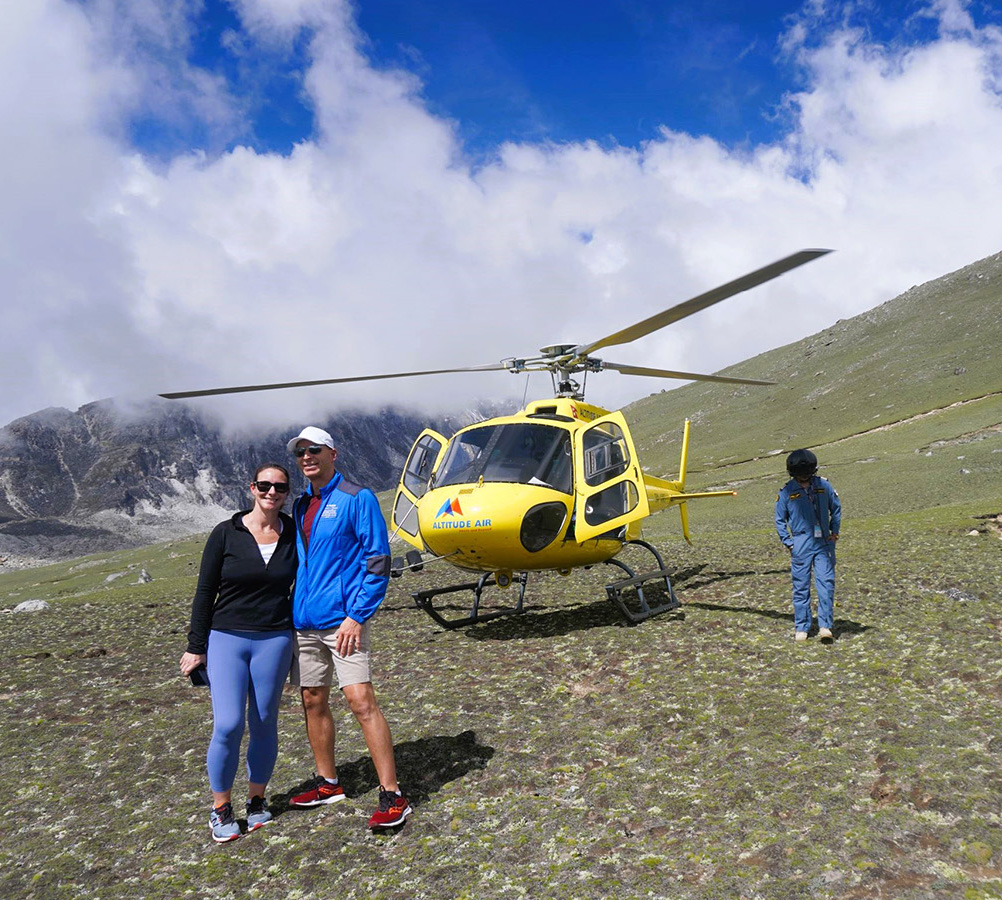
For those on a private or semi-private flight, the helicopter sets down at the base of Kalapathar — the rocky black ridge at 5,250 metres that offers the most direct, unobstructed view of Mount Everest available anywhere without a rope. You step out into thin air, cold silence, and one of the most extraordinary vistas on the planet. Everest, at roughly 10 kilometres’ aerial distance, fills the skyline.
Time at altitude is kept intentionally short — ten to fifteen minutes — then the helicopter lifts and heads toward its second stop.
Breakfast at the Roof of the World
The Everest View Hotel sits at 3,880 metres on a ridge above Namche Bazaar, and has held the Guinness World Record for the highest placed hotel on earth for decades. The tour includes an hour here — long enough for a full breakfast on the sun-drenched terrace with Everest, Ama Dablam, and Lhotse forming a backdrop that no restaurant on earth can match. The hotel serves a set breakfast of eggs, bread, and hot drinks. Many travellers say this hour, sitting quietly with a coffee in the shadow of the world’s tallest mountain, stays with them longer than the flyover itself.
The return flight to Kathmandu arrives by late morning, typically before noon which means the entire experience unfolds within a single half-day.
Who This Tour Is For
The honest answer is: almost anyone. The minimum age is five and the tour regularly welcomes guests into their late seventies. No physical training is required. No previous trekking experience is needed. The altitude exposure is brief enough that most healthy travellers manage it comfortably, though anyone with a heart condition or serious respiratory issue should consult a doctor beforehand.
It suits travellers with limited time in Nepal who want to experience the Khumbu without a fourteen-day trek. It suits families where some members cannot trek at altitude but all want to see Everest. It suits photographers who want that singular aerial perspective of the Khumbu Icefall. And it suits anyone returning to Nepal who has already done the trek and wants to see the same landscape from a completely different angle.
Group Sharing vs. Private Charter
The tour operates daily on both a group-sharing and private-charter basis, accommodating up to five passengers per flight. Group sharing brings the per-person cost down significantly and works well for solo travellers or couples happy to join existing departures. Private charter gives you full flexibility over pacing, seating, and the option of landing at Kalapathar rather than flying over it — a meaningful difference when you arrive and realise how extraordinary that touchdown actually is.
The Best Time to Go
October through May covers the two prime windows. Autumn — particularly October and November — delivers the clearest skies and sharpest visibility of the year. Spring from March to May is equally reliable, with the added bonus of rhododendrons in bloom across the lower hillsides on the outbound flight. Flights operate year-round, but the monsoon months of June through September bring cloud cover that can limit views and occasionally ground flights altogether.
A Few Things Worth Knowing
The helicopter does not land at Everest Base Camp proper. The glacier terrain is unstable and the environmental impact of regular landings there would be significant responsible operators respect this and opt for the Kalapathar viewpoint instead, which actually offers a cleaner sightline to Everest than the base camp itself. Landing directly at EBC is available in April and May only, as a private charter option at additional cost, when expedition teams create a temporary helipad.
Warm layers are essential, temperatures at Kalapathar run well below zero in the shade, even on clear spring days. Sun protection matters too; UV intensity at altitude is considerably stronger than at sea level.
If your flight is cancelled due to weather, a full refund applies. Early morning departures exist precisely because the Himalayan atmosphere is calmest at dawn, the window closes quickly as the day warms.
The Bottom Line
The Everest Base Camp Helicopter Tour does not replace the trek. Nothing does. But it offers something the trek cannot. The entirety of the Khumbu in a single morning, from a vantage point no road and no trail will ever reach, finished in time for lunch back in Kathmandu.
For those who have dreamed of seeing Everest up close and want to do it today rather than in two weeks, this is the best version of that experience that exists.
Recent Posts