12 Days Nepal Discovery Tour
12 Days Nepal Discovery
Heritage · Culture · Trekking · Wildlife — Nepal’s Most Complete Classic Tour
The 12 Days Nepal Discovery Tour is the country’s most complete introductory itinerary — a single journey that takes you from the ancient temple squares of Kathmandu to a sunrise panorama of the Himalaya, through the forested hills of the Annapurna region, and into the heart of one of Asia’s finest wildlife sanctuaries. In twelve days, you experience four of Nepal’s most iconic destinations, cover two UNESCO World Heritage Sites, complete a classic Himalayan trek, and encounter Bengal tigers, one-horned rhinos, and over 450 species of birds in their natural habitat.
This is the tour that answers the most common question first-time Nepal visitors ask: ‘If I only come once, what should I do?’ The answer is everything on this list. Kathmandu’s sacred streets. The view from Poon Hill at dawn. The terraced villages of Ghandruk. The Rapti River at sunrise with rhinos on the bank. One trip. Twelve days. Every essential Nepal experience included.
The itinerary is carefully paced to balance activity with rest, adventure with culture, and physical challenge with genuine comfort. The Poon Hill trek section is graded easy to moderate and is achievable by any reasonably fit traveller — no technical climbing, no extreme altitude, no prior trekking experience required. Expert local guides accompany you throughout, bringing the history, ecology, and culture of Nepal to life at every step.
Tour Highlights
- Bhaktapur Durbar Square — a living medieval city and UNESCO World Heritage Site, with the finest concentration of Newari architecture in Nepal
- Boudhanath Stupa — one of the world’s largest Buddhist stupas, surrounded by active Tibetan monasteries and centuries of living spiritual tradition
- Kathmandu Durbar Square — ancient royal palaces, temples, and the famous Kumari Ghar in the historic city core
- Scenic flight Kathmandu to Pokhara with Himalayan mountain views en route
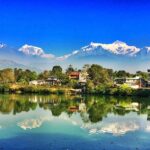
- Phewa Lake, Pokhara — the iconic lakeside town beneath the Annapurna range, with Machhapuchhre reflected in still water
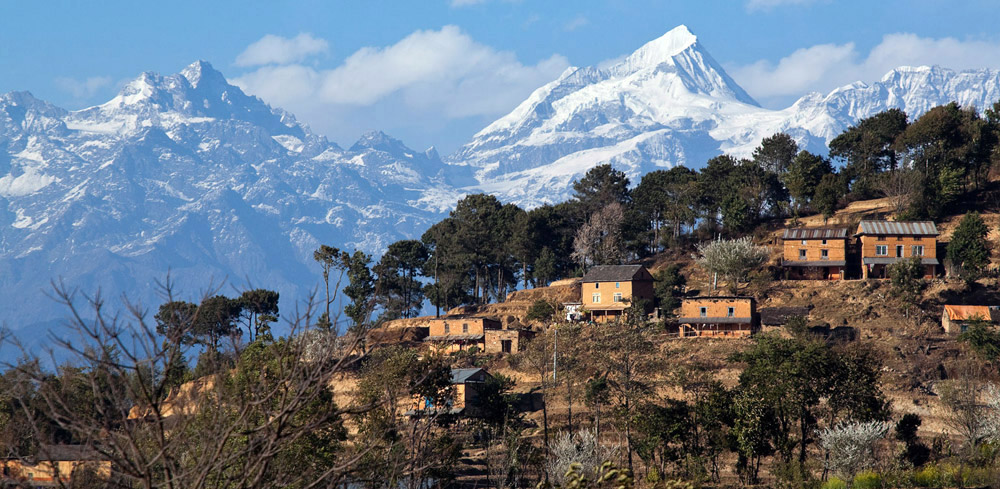
- Poon Hill sunrise (3,210 m) — Nepal’s most celebrated viewpoint, with a panoramic arc of Dhaulagiri, Annapurna, Nilgiri, and Machhapuchhre
- Rhododendron and oak forests of the Ghorepani–Tadapani corridor — among Nepal’s most beautiful forest trails
- Ghandruk village — the largest and most culturally rich Gurung village in the Annapurna region
- Chitwan National Park — UNESCO World Heritage Site and home to Bengal tigers, one-horned rhinos, Asian elephants, sloth bears, and 450+ bird species
- Jeep safari and canoe ride on the Rapti River
- Tharu cultural village visit and traditional dance performance
- Rickshaw tour through old Kathmandu — a perfectly paced conclusion through the city’s historic lanes
Itinerary at a Glance
| Day | Route / Activity | Overnight | Meals |
| 01 | Arrive Kathmandu — airport welcome & transfer | Kathmandu | Welcome Dinner |
| 02 | Bhaktapur Durbar Square + Boudhanath Stupa | Kathmandu | B, D |
| 03 | Fly Kathmandu → Pokhara — lakeside arrival | Pokhara | B, L |
| 04 | Drive to Nayapul — trek to Tikhedhunga (1,540 m) | Tikhedhunga | B, L, D |
| 05 | Trek Tikhedhunga → Ghorepani (2,860 m) | Ghorepani | B, L, D |
| 06 | Poon Hill sunrise (3,210 m) → trek to Tadapani (2,630 m) | Tadapani | B, L, D |
| 07 | Trek Tadapani → Ghandruk (1,940 m) | Ghandruk | B, L, D |
| 08 | Trek Ghandruk → Nayapul → drive to Pokhara | Pokhara | B, L, D |
| 09 | Drive Pokhara → Chitwan National Park | Chitwan | B, L, D |
| 10 | Full day Chitwan — jeep safari, canoe, Tharu village | Chitwan | B, L, D |
| 11 | Fly Chitwan → Kathmandu — rickshaw tour, Durbar Square | Kathmandu | B, D |
| 12 | Departure from Kathmandu | — | B |
B = Breakfast L = Lunch D = Dinner
Day-by-Day Itinerary
Day 01 — Arrival in Kathmandu
Meals: Welcome Dinner
Your Nepal journey begins the moment you land at Tribhuvan International Airport in Kathmandu. A tour representative will be waiting to greet you with a warm Nepali welcome — Namaste — and transfer you comfortably to your hotel in the heart of the city.
The afternoon and evening are yours to settle in at your own pace. Wander the vibrant streets of Thamel, pick up last-minute trekking supplies, or simply relax in the hotel and begin absorbing the energy of this extraordinary ancient city. Kathmandu is one of the few capitals in the world where 12th-century temples stand beside modern cafes, and where the scent of incense mingles with the sound of street vendors and motorcycle horns. It asks nothing of you on your first evening except that you arrive.
Your welcome dinner this evening is a perfect introduction to Nepali cuisine — dal bhat, momos, and the warmth of Nepali hospitality that you will encounter at every step of the journey ahead.
Day 02 — Bhaktapur Durbar Square & Boudhanath Stupa
Meals: Breakfast, Dinner
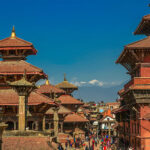
After breakfast, you drive 13 km east of Kathmandu to Bhaktapur — the ‘City of Devotees’ and the former capital of the Kathmandu Valley until the 15th century. This UNESCO World Heritage Site is Nepal’s most perfectly preserved medieval city, with barely a modern building to interrupt its extraordinary streetscape of Newari brick architecture, carved wooden windows, and stone-paved courtyards.
Your expert guide leads you through Dattatraya Square — an open-air museum of ancient temples and woodcarvings centred on the Dattatreya Temple, one of Nepal’s oldest structures — and into the famous Pottery Square, where traditional artisans work at hand-turned wooden wheels, shaping clay into pots and storage vessels that have supplied the valley for centuries. Bhaktapur Durbar Square itself, flanked by the 55-Window Palace and the Golden Gate, is a place where time seems to have paused deliberately.
In the afternoon, you return toward Kathmandu to visit Boudhanath Stupa — one of the largest Buddhist stupas in the world and a UNESCO World Heritage Site. The stupa’s great white dome, surmounted by the watchful eyes of the Buddha painted on its gilded tower, presides over a circular plaza ringed by Tibetan monasteries and butter-lamp shrines. Walking the kora (circumambulation circuit) in the late afternoon, as monks in saffron and maroon robes complete their evening prayers and the incense smoke rises through the golden light, is one of Kathmandu’s most serene and memorable experiences.
Day 03 — Fly Kathmandu to Pokhara
Meals: Breakfast, Lunch
After breakfast, you are transferred to the airport for a short and spectacular 25-minute scenic flight to Pokhara. On clear days, the flight offers a privileged aerial view of the Himalayan chain — the snow-capped summits of Ganesh Himal, Manaslu, and the Annapurna range stretching across the northern horizon at eye level, a perspective that no ground journey can replicate.
Pokhara arrives below as a broad valley lakeside city at 827 metres, its atmosphere immediately calmer and warmer than Kathmandu. Often called the ‘City of Lakes’, Pokhara is the adventure capital of Nepal and simultaneously one of its most restful destinations — a city built for lingering. Check in to your lakeside hotel, then spend the afternoon exactly as you choose. A quiet boat ride on Phewa Lake, a coffee at a lakeside cafe with Machhapuchhre (Fishtail Mountain) reflected in the water, a stroll along the Lakeside promenade, or simply sitting on a terrace watching the mountains turn pink in the evening light.
Your trekking guide meets you this evening to walk through the next five days of trail, answer all questions about the route and pacing, and ensure you are fully prepared for the adventure ahead.
Day 04 — Pokhara to Nayapul — Trek to Tikhedhunga
1,540 m | Meals: Breakfast, Lunch, Dinner
Your trekking adventure begins this morning. After an early breakfast, you board the vehicle for the 90-minute drive west of Pokhara to Nayapul, a busy roadside town at the start of the Annapurna trail network. From here the trail takes over — no more roads, no more vehicles, just your boots, the path, and the mountains.
The first section of the trail follows the banks of the Modi Khola River through Birethanti, a pretty suspension-bridge village where trekking permits are checked, and continues through terraced farmlands of rice, millet, and maize belonging to Magar and Gurung farming communities. The path is wide, well-maintained, and gently ascending, with the sounds of the river accompanying you through the lower valley.
As the trail climbs from Hile toward Tikhedhunga, the vegetation thickens and the first stone teahouses of the Annapurna circuit appear beside rushing streams and small waterfalls. Tikhedhunga is a peaceful overnight stop — a cluster of lodges on a hillside above the Modi Khola, with the sound of the river below and the first real views of the surrounding ridgelines above. Your first night in a traditional Himalayan teahouse: simple, warm, and exactly right.
Day 05 — Tikhedhunga to Ghorepani
2,860 m | Meals: Breakfast, Lunch, Dinner
Today begins with the most famous ascent in the Annapurna foothills — the Ulleri stone steps. Over 3,000 stone steps rise steeply from the river valley to the village of Ulleri at 1,960 m, and then the trail continues upward through increasingly dense forest. It is a climb that demands steady pacing and earns its reward in the views that open progressively as you gain height — the valley below deepening, the ridges of the Annapurna range appearing above the treeline.
Above Ulleri, the landscape changes character. The forest becomes dense and multi-layered — rhododendron, oak, and magnolia giving way to richer mosses and ferns as the altitude increases. In spring (March to April) this section is covered in rhododendron bloom: Nepal’s national flower in red, pink, and white, covering entire hillsides in colour. In autumn, the forest is golden and the air is crystalline.
Ghorepani (2,860 m) arrives in the mid-afternoon — a prosperous Magar village perched on a high ridge, its lodges stacked above each other with south-facing terraces looking out over an extraordinary panorama of the Annapurna range. Dhaulagiri (8,167 m) is visible to the west for the first time. The air is noticeably cooler and cleaner than in the valley below. A warm meal, a hot drink, and an early night — tomorrow’s sunrise requires a pre-dawn departure.
Day 06 — Poon Hill Sunrise (3,210 m) — Trek to Tadapani
3,210 m to 2,630 m overnight | Meals: Breakfast, Lunch, Dinner
Wake at 4:30 AM. The sky above Ghorepani is full of stars. Your guide leads you up the 45-minute trail to Poon Hill in the dark, headlamps cutting through the pre-dawn cold, past the prayer flags that mark the final ridge, and onto the famous viewpoint platform at 3,210 metres.
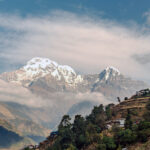
Then the mountains appear. As first light touches the highest peaks — Annapurna I (8,091 m), Annapurna South, Hiunchuli, Nilgiri North, Dhaulagiri (8,167 m), and the unmistakable double-pointed summit of Machhapuchhre (Fishtail) — they turn from pale grey to rose to brilliant gold in the space of ten minutes. It is one of Nepal’s great spectacles and one that no photograph fully prepares you for. Poon Hill is justifiably Nepal’s most celebrated short-trek viewpoint, and on a clear morning it delivers everything it promises.
Breakfast back in Ghorepani, then the day’s main trail begins — a beautiful traverse east through the high forests toward Tadapani. This section of trail is enchanting: high ridge walking with alternating views of the Annapurna and Dhaulagiri ranges, through rhododendron groves where Himalayan tahr occasionally graze in the clearings. Tadapani (2,630 m) sits on a forested ridge with close-up views of Annapurna South filling the northern sky — a dramatically beautiful overnight stop.
Day 07 — Tadapani to Ghandruk
1,940 m | Meals: Breakfast, Lunch, Dinner
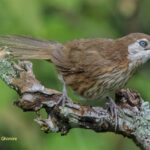
A descent day through beautiful forest, arriving at one of the most rewarding villages on the entire Annapurna trekking network. From Tadapani, the trail drops through dense oak and rhododendron forest alive with birdlife — this section is particularly rich for Himalayan monal (Nepal’s national bird), blood pheasant, and various species of thrush and warbler — before opening out into the broad valley above Ghandruk.
Ghandruk (1,940 m) is the largest Gurung village in the Annapurna region and one of the most culturally rich settlements accessible without technical trekking experience. The village is a maze of stone-paved lanes, traditional slate-roofed houses, and terraced vegetable gardens that have been farmed by Gurung families for generations. The view of Annapurna South from Ghandruk’s upper lanes — filling the sky directly to the north with only the village rooftops in the foreground — is one of the most intimate mountain views in Nepal.
The Gurung Museum in the upper village documents the military heritage of the Gurung people, who have contributed legendary soldiers to the British and Indian Gurkha regiments for over 200 years. The evening in Ghandruk is the trek’s cultural highlight — a relaxed exploration of the village at sunset, with Annapurna South glowing orange above the rooflines.
Day 08 — Ghandruk to Nayapul — Drive to Pokhara
827 m | Meals: Breakfast, Lunch, Dinner
The final morning of the trek. After breakfast in Ghandruk, take a last long look at Annapurna South from the village, then begin the descent through terraced fields and small Gurung hamlets toward Nayapul. The trail descends easily alongside the Modi Khola River, and the transition back toward the roadhead is gradual — the landscape opening, the villages becoming larger, the sound of traffic eventually replacing the sound of the river.
Your vehicle meets you at Nayapul for the 90-minute drive back to Pokhara. Arriving in Lakeside by mid-afternoon, the contrast with the teahouses of the high trail is striking: a hot shower, a proper bed, a restaurant menu with more than five options. Spend the afternoon and evening celebrating the completion of the Poon Hill circuit — a celebratory dinner at one of Pokhara’s excellent restaurants on the lake, with Annapurna still visible in the evening sky to the north.
Day 09 — Drive Pokhara to Chitwan National Park
150 m | Meals: Breakfast, Lunch, Dinner
After breakfast, leave the mountains behind and head south toward Nepal’s subtropical lowlands. The drive from Pokhara to Chitwan takes approximately 5 to 6 hours and follows the Prithvi Highway through the Marsyangdi and Trishuli river valleys before descending into the Terai — Nepal’s flat southern plains — and arriving at the wildlife buffer zone surrounding Chitwan National Park.
The journey itself is scenic, tracing river corridors through forested gorges that transition gradually from the temperate hill forests to the tropical and subtropical vegetation of the Terai. By the time your vehicle reaches the Chitwan area, the air is warmer, the light is softer, and the flora has transformed entirely — silk-cotton trees, sal forests, and the tall elephant grass of the park’s grassland edges replacing the rhododendron and pine of the mountains.
Your jungle lodge sits on the northern boundary of the park, often within sight and sound of the Rapti River, where rhinos wade in the early morning mist. This evening, an introductory briefing from your naturalist guide covers the park’s ecology, the wildlife you are likely to encounter, and the full programme for the following day.
Day 10 — Full Day Chitwan National Park
150 m | Meals: Breakfast, Lunch, Dinner
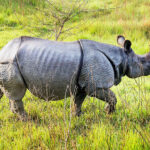
A full day in one of Asia’s finest national parks, with the richest wildlife viewing available on this itinerary. Chitwan National Park covers 932 square kilometres of subtropical grassland, riverine forest, and sal forest in the inner Terai, and holds one of the highest concentrations of one-horned rhinoceros in the world alongside significant populations of Bengal tiger, Asian elephant, sloth bear, gaur, four-horned antelope, and gharial crocodile.
Your day begins before dawn with a 4WD jeep safari deep into the park — the most effective way to access the park’s interior and the habitats where large mammals are most active in the early hours. Your expert naturalist guide reads the landscape with a practised eye, stopping for rhinos grazing in the grassland edges, watching a pair of sarus cranes by the riverbank, or tracking fresh pugmarks through the forest floor. Sightings of the one-horned rhino are almost guaranteed; Bengal tiger sightings, while not assured, are more likely here than in almost any other accessible park in the subcontinent.
The afternoon brings a canoe glide on the Rapti or Narayani River — a quiet, paddle-powered drift along the river corridor that brings you within a few metres of gharial crocodiles basking on the banks and offers exceptional birdwatching from the water. A visit to a nearby Tharu cultural village rounds out the day — the Tharu are the indigenous people of the Terai lowlands, with a distinctive architecture, weaving tradition, and a relationship with the forest that predates the park’s establishment by centuries. A traditional Tharu cultural dance performance in the evening is a warm and authentic conclusion to an extraordinary day in the wild.
Day 11 — Fly to Kathmandu — Rickshaw Tour & Durbar Square
1,400 m | Meals: Breakfast, Dinner
After a final early-morning game drive or nature walk at Chitwan, you transfer to Bharatpur Airport for the 30-minute domestic flight back to Kathmandu. Arriving by mid-morning, check in to your hotel and take time to rest, refresh, and absorb the contrast between the jungle lowlands and the ancient mountain city.
In the afternoon, you board a traditional cycle rickshaw for one of Kathmandu’s most enjoyable experiences — a slow, low-level journey through the narrow lanes of the old city, weaving between temples, shrines, market stalls, and school children, with the driver navigating the medieval street geometry that no car could manage. The rickshaw delivers you to Kathmandu Durbar Square — the historic royal plaza at the heart of the old city, surrounded by a remarkable concentration of temples, palaces, and courtyards built between the 12th and 18th centuries.
Explore the Hanuman Dhoka Palace complex, the Kumari Ghar (home of the Living Goddess), and the extraordinary carved woodwork of the surrounding temples. Your guide brings this dense, layered history to life in the afternoon light. A farewell dinner together this evening celebrates everything you have experienced in twelve extraordinary days.
Day 12 — Departure from Kathmandu
Meals: Breakfast
Your final morning in Nepal. After breakfast, spend any remaining time as you choose — a last walk around Thamel, a few more minutes at Boudhanath, final souvenir shopping, or simply sitting on the hotel terrace with a cup of masala tea and the Kathmandu morning going about its ancient routine around you.
Your tour representative will escort you from your hotel to Tribhuvan International Airport in good time for your departure flight, and will be on hand until your final check-in is complete. From the aircraft window as you lift above the Kathmandu Valley, look north — if the sky is clear, the Himalayan chain will be there for a final farewell, white and enormous and entirely itself. Safe travels, and Namaste.
What Is Included
- 11 nights accommodation — 3 nights Kathmandu (3-star hotel), 1 night Pokhara pre-trek (3-star hotel), 4 nights teahouses on the Poon Hill trek, 1 night Pokhara post-trek, 2 nights Chitwan jungle lodge
- All meals as per itinerary (B = Breakfast, L = Lunch, D = Dinner)
- Welcome dinner and farewell dinner
- All transport: airport transfers, domestic flights Kathmandu–Pokhara and Bharatpur–Kathmandu, road transfers by private vehicle
- Expert English-speaking guide throughout the full 12-day tour
- Licensed trekking guide and porter for the Poon Hill trek section (Days 4–8)
- Chitwan National Park entry fees and all park activities: jeep safari, canoe river trip, nature walk, Tharu village visit
- Bhaktapur entry fee, Kathmandu Durbar Square entry fee
- Poon Hill trekking permits (ACAP + TIMS)
- All government taxes and service charges
- Farewell certificate of participation
What Is Not Included
- International airfare to/from Kathmandu
- Nepal entry visa (available on arrival — USD 0 for 15 days, USD 0 for 30 days)
- Travel insurance (mandatory — must cover trekking and medical evacuation)
- Personal trekking equipment (sleeping bag, trekking poles, boots — available to rent in Kathmandu and Pokhara)
- Personal expenses: phone calls, laundry, bar bills, tips, and souvenirs
- Additional activities not listed in the itinerary
- Meals not listed in the itinerary
- Tips and gratuities for guides, drivers, and teahouse staff
- Any costs arising from flight delays, cancellations, or weather-related itinerary changes
Practical Information
Difficulty and Fitness
The 12 Days Nepal Discovery Tour is graded easy to moderate overall. The cultural days in Kathmandu and Pokhara involve light walking only. The Poon Hill trek section (Days 4–8) requires moderate physical fitness — you will walk 4–7 hours per day on well-maintained mountain trails, with the steepest section being the Ulleri stone steps on Day 5. No technical climbing, no glacier crossings, and no altitude above 3,210 m. Any reasonably active person aged 12–70 who walks regularly can complete this trek comfortably with proper pacing. The Chitwan days are entirely non-strenuous.
Best Season
- Autumn — September to November: Post-monsoon clarity delivers the sharpest mountain views at Poon Hill and the best wildlife visibility at Chitwan. October is Nepal’s finest month.
- Spring — March to May: Rhododendron forests between Tikhedhunga and Ghorepani are in full bloom. March and April are particularly recommended.
- Winter — December to February: Quieter, cooler, and often very clear. Mountain views can be exceptional. Chitwan is excellent in winter.
Accommodation
In Kathmandu and Pokhara, you stay in comfortable 3-star hotels with private rooms, en-suite bathrooms, Wi-Fi, and good restaurant facilities. On the trek (Days 4–8), accommodation is in traditional Himalayan teahouses — family-run mountain lodges with simple private or shared rooms, communal dining rooms, and hearty mountain food. In Chitwan, you stay in a jungle lodge on the park boundary with comfortable rooms and a full wildlife activity programme.
What to Pack
- Trekking boots (broken in before departure) and comfortable walking shoes for cultural days
- Warm layers for the trek: down jacket, fleece, thermals — temperatures at Ghorepani drop to 5–10°C at night even in October
- Waterproof jacket and trousers, sun hat, warm hat, light gloves, sunscreen SPF 50+, sunglasses
- Light cotton clothing for Chitwan and Kathmandu; insect repellent (essential for Chitwan)
- Personal first aid kit, reusable water bottle, portable power bank, and sufficient Nepali Rupee cash for personal expenses
Visas and Travel Insurance
Most nationalities obtain a Nepal Tourist Visa on arrival at Kathmandu airport. Bring your passport, two passport-sized photographs, and USD cash: USD 0 for 15 days or USD 0 for 30 days. Comprehensive travel insurance is mandatory and must cover medical expenses, emergency evacuation, and trekking activities up to 4,000 m altitude.
Frequently Asked Questions
Do I need prior trekking experience for the Poon Hill section?
No. The Poon Hill trek is Nepal’s most accessible multi-day mountain experience. The trail is well-maintained and clearly marked, and the maximum altitude of 3,210 m is well below the threshold where serious altitude sickness becomes likely. Fit beginners complete this trek every day of the season. What helps most is arriving with a good base level of fitness — if you can walk uphill for two hours without stopping, you are prepared.
Can children join this tour?
Yes. Children aged 10 and above handle the Poon Hill trek comfortably. The cultural days in Kathmandu and Bhaktapur are engaging and age-appropriate. The Chitwan wildlife days are genuinely thrilling for young visitors. Specific family accommodation arrangements, reduced-pace trekking schedules, and child-friendly meal options are all available on request.
What happens if a domestic flight is cancelled?
Domestic flight delays are occasionally caused by weather in Nepal. We build flexible scheduling into the itinerary to accommodate this. In the event of a cancellation, we arrange alternative road transport where feasible or reschedule the flight at the earliest opportunity with no additional cost to you. We recommend building a buffer day before your international departure.
Will I see tigers at Chitwan?
Chitwan has one of the highest tiger densities of any accessible wildlife park in Asia. Sightings during jeep safaris are genuinely possible and occur regularly in the early morning. However, no wildlife encounter can be guaranteed. What is virtually guaranteed is a close encounter with one-horned rhinos, which are frequently seen at close range during both jeep safaris and canoe trips.
Is this tour available as a private departure?
Yes. This tour operates as a fully private experience for individuals, couples, families, and small groups on any date throughout the year. Private departures allow complete flexibility in pacing, accommodation preferences, and optional activity additions. Contact us directly to discuss a private itinerary tailored to your preferences.
Book This Tour
The 12 Days Nepal Discovery Tour is available year-round for private groups and weekly for fixed departures during peak season. All bookings include a detailed pre-departure information pack, 24/7 in-country support, and our risk-free amendment policy for weather-related schedule changes.
Tour Code: NPL-12-DISCOVERY
Duration: 12 Days / 11 Nights
Minimum Pax: 2 persons (private departures available for solo travellers on request)
Start / End: Kathmandu, Nepal
Included Flights: Kathmandu–Pokhara + Bharatpur–Kathmandu (domestic)
Trek Grade: Easy to Moderate — no technical experience required
Best Months: October, November, March, April (year-round operation)
Contact our team to check availability, request a detailed quotation, or discuss a custom variation of this itinerary. We look forward to welcoming you to Nepal.
Recent Posts