14 Things to Do in Nepal That Are Totally Non-Touristy
Most people arrive in Nepal with a version of the same plan: Everest Base Camp or Annapurna Circuit, a morning at Boudhanath, a half-day at Pashupatinath, some momos in Thamel. That’s Nepal filtered through two decades of travel content the same sixteen photographs recycled across a thousand blogs. It’s not that those experiences aren’t real or worthwhile. It’s that Nepal runs about ten layers deeper than that version of itself, and almost none of those layers appear on any itinerary a travel agent will build you without being specifically asked.
The Nepal that locals actually live in the highway sekuwa stops, the medieval Newari towns that see almost no foreign visitors, the tea gardens of Ilam, the Mithila art cooperatives of Janakpur, the aila-drinking culture of Kirtipur, the dawn cremation rituals that tourists photograph from a distance but rarely understand that Nepal is entirely accessible. It just requires stepping deliberately off the well-worn path and staying off it long enough for something genuine to happen.
These 14 experiences are the ones that do that.
1. Eat a Full Newari Feast in Kirtipur — Not a Restaurant Version, a Real One
Kirtipur is 5 kilometers southwest of Kathmandu and receives a fraction of the visitors that Bhaktapur and Patan pull daily, despite being arguably the most culturally intact Newari town in the entire valley. The old town sits on a double ridge, its stone lanes narrow enough that two people passing each other with bags require negotiation, its temple courtyards entirely free of souvenir stalls.
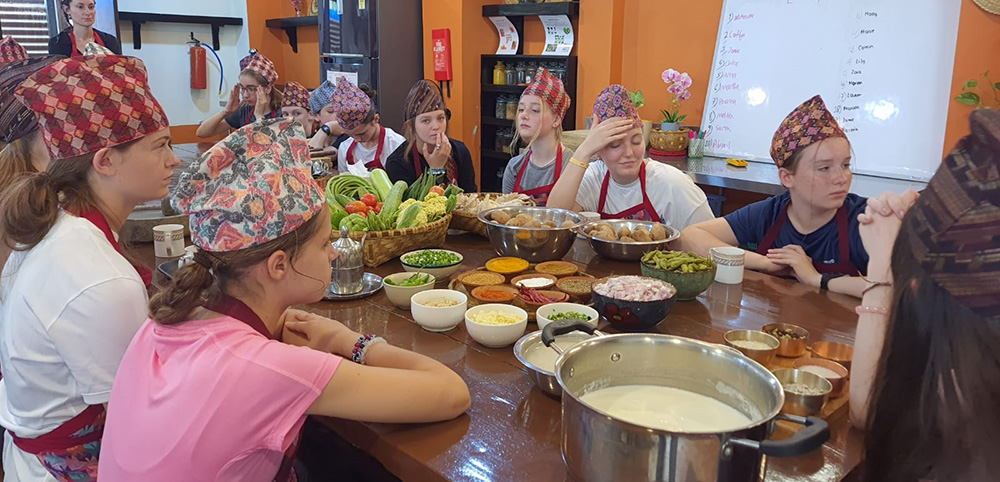
What Kirtipur holds that nowhere else in Nepal replicates is the density of its authentic Newari food culture. Newa: Lahana — a community-run restaurant operated by local women — serves a full Newari feast: beaten rice (chiura) with black soybean (bhatmaas), buffalo meat curry (choila), taro leaves cooked in mustard oil, dried fish with sesame seeds, aloo achar, bara (lentil pancakes fried crisp), and a small clay cup of aila — the rice-based distilled spirit that Newari households have been making for centuries. This is not fusion, not adaptation, not presentation for tourists. This is what Kirtipur has been eating for five hundred years.
Go on: Any morning from 9 AM. Combine with a walk through the old lanes and the Uma Maheshwar temple courtyard. Budget around NPR 600–900 per person for the full feast.
2. Ride a Local Public Bus Between Kathmandu and Pokhara — No Private Car
Every traveler between Nepal’s two major cities books a tourist bus or private vehicle. It’s comfortable, direct, and utterly insulated from everything that happens in Nepal at road level. The local public bus — NPR 500 to 700, 7 to 8 hours, departing from Kalanki bus park is a fundamentally different experience.
You board before dawn into a bus that smells of incense and diesel. By the time the sun rises you’re crawling through Malekhu gorge where the Trishuli River runs turquoise beside the road. At Mugling, everyone piles off for dal bhat at roadside dhaba stalls where the food is cooked fresh over wood fire, the tea comes in glasses, and locals spread newspapers on shared benches without a single acknowledgment that a foreign traveler is sitting alongside them. This is highway Nepal — the version that moves on its own schedule, stops when it wants, and has no interest in performing itself for anyone.
Insider tip: Sit on the right-hand side of the bus for the best views of the Trishuli gorge between Malekhu and Muglin. Carry snacks and water but eat the dal bhat at Mugling — it’s genuinely good.
3. Walk the Ason Bazaar Before 7 AM
Thamel, directly to the north, is where tourists buy trekking gear and overpriced coffee. Ason Bazaar, a 15-minute walk southeast through narrow lanes, is where Kathmandu actually shops. The bazaar dates to the medieval Malla period and has been continuously operating since — a central square ringed by temples, its lanes radiating outward into specialty wholesale blocks: dried spices in open sacks, mustard oil dispensed by the liter from drums, flower marigold garlands stacked by the arm-load for morning temple offerings, incense sticks bundled by the thousand, and fresh vegetables arriving by porter from the valley’s farming periphery.
Before 7 AM, before the day’s traffic turns everything into noise, Ason belongs entirely to the people who use it daily. Shopkeepers perform their morning puja at the small temple at the bazaar center. Women in saris carry loaded dokos (woven baskets) on their backs. The smells are turmeric, mustard, and marigold. The whole scene operates on a rhythm that’s been the same for centuries and has no interest in adapting itself for visitors.
Go on: Any day. Tuesday and Saturday see larger market crowds. Take a local tea at one of the chiya stalls on the bazaar edge — NPR 15, served in a small glass, and the best cup of tea you’ll drink in Nepal.
4. Visit the Janakpur Women’s Development Center
Janakpur sits 225 kilometers southeast of Kathmandu, in the Terai lowlands near the Indian border, and receives almost no foreign tourists despite containing one of Nepal’s most architecturally distinctive temples — the Janaki Mandir, built in neo-Rajput Mughal style in 1911, its white marble and ornate turrets entirely unlike anything in the hill country. But the real reason to make the trip is not the temple. It’s the Janakpur Women’s Development Center.
Founded in 1989, the center brings together women from the surrounding Mithila region villages to practice and preserve a 3,000-year-old tradition of Maithili folk painting — complex, mandala-like compositions in natural earth pigments, originally created by Brahmin women on the walls of their homes during courtship and wedding ceremonies. The center now has separate studios for painting, ceramics, screen-printing, and sewing. Visitors are genuinely welcome — not in a curated museum sense, but in the sense that artists are working, will stop and show you what they’re doing, and will explain the symbolism encoded in the patterns if you ask. The gift shop sells work made entirely on the premises.
Getting there: 45-minute flight from Kathmandu, or a 6-hour bus. Janakpur deserves at least one overnight. Best time to visit: November for Chhath Puja — the most extraordinary public ritual festival in Nepal’s Terai, when thousands gather at the sacred ponds for pre-dawn prayers to the sun.
5. Spend a Morning at a Himalayan Tea Garden in Ilam
Ilam is Nepal’s tea capital — a hill district in the far east of the country, bordering Darjeeling across the Indian state of Sikkim, producing orthodox teas that connoisseurs rank among the finest high-grown teas in Asia. Almost no international travelers go there. The ones who do usually spend 20 minutes photographing the tea garden and leave. What Ilam actually offers is an entire day of walking through the plantations with a local guide who knows the difference between the spring first flush and the autumn second, visiting small artisan processors where leaves are withered, rolled, and oxidized by hand, and drinking freshly made tea at source in the garden itself — a flavor and freshness that packaged tea simply cannot replicate.
The Ilam town bazaar is relaxed, genuinely local, and interesting in the way only places that don’t know they’re supposed to be tourist destinations can be. The surrounding hills support red panda habitat, and the Kanyam ridgeline nearby has mountain views extending to Kanchenjunga on clear days.
Getting there: Fly to Bhadrapur (1.5 hours from Kathmandu), then drive 3 hours to Ilam. Insider tip: Visit between late March and May for the first flush harvest season — the most active period in the gardens, when fresh leaves are being processed daily.
6. Attend a Guthi Feast in a Newari Neighborhood
Nepal’s travel writing almost never mentions the guthi system, but it’s one of the most fascinating social institutions in the country. A guthi is a Newari community organization — a mutual aid and cultural preservation society that manages neighborhood temples, organizes festivals, performs collective death rituals, and maintains the social fabric of traditional Newari urban life. Every Newari neighborhood has one. Every active guthi holds regular communal feasts — large gatherings where the community eats together, seated in long rows on the floor, served from shared pots.
Attending a guthi feast as an outsider requires a local connection — a Newari neighbor, a guide from the community, or a homestay host willing to bring you along. It is not bookable online. It is not a cultural performance. It’s a working social institution having dinner. The food is extraordinary — a full Newari spread prepared in the neighborhood’s communal kitchen, eaten from leaf plates, with aila passed between guests — but the real thing is the sense of a community operating on a thousand-year-old social contract that has nothing to do with the outside world.
How to access it: Ask through a local guide specifically from a Newari community. Patan, Bhaktapur, and Kirtipur all have active guthi systems. Patience and genuine relationship-building are required. This is not something to rush.
7. Take a Local Ferry Across the Karnali River in Western Nepal
Western Nepal — the Karnali zone specifically — is where the country’s tourism infrastructure essentially stops. The highways thin out, the signage disappears, and the Karnali River runs wide and fast through a landscape of terraced hillsides and sal forest where the infrastructure connecting communities is sometimes a seasonal rope bridge, sometimes a small wooden ferry, and sometimes nothing but a ford.
The local ferry crossing at Rajapur or Chisapani on the lower Karnali is not a tourist attraction. It’s how people get from one side of the river to the other — farmers, traders, schoolchildren, and the occasional motorcycle loaded with rice sacks. Boarding involves waiting on the bank, negotiating in Nepali, sitting on a plank above river water the color of milky jade, and arriving at the other bank having had approximately zero interaction with anything designed for tourist consumption. It’s a small thing. It leaves a disproportionate impression.
Context: Combine with a visit to Bardia National Park in western Nepal — one of the best tiger habitats in Asia and significantly less visited than Chitwan. The local ferry experience fits naturally into a western Nepal itinerary.
8. Watch a Lakhe Dance Rehearsal in a Kathmandu Backstreet
The Lakhe — a demon figure in a red and black costume with a dramatic carved mask, long black hair, and bells strapped to its legs — is one of the most recognizable figures in Newari festival culture. During Indra Jatra (September) it dances publicly through Kathmandu’s streets to enormous crowds. What almost no tourist ever sees is the rehearsal process — weeks of evening practice sessions held in the courtyards of the neighborhoods responsible for maintaining the Lakhe tradition, where young men learn the specific footwork, the head movements, and the rhythm of the drums that give the dance its character.
These rehearsals happen in places like Nhu Guthi in Kathmandu or specific courtyards in Bhaktapur — not on any map, not advertised anywhere. They’re community practice sessions that happen to be open courtyards. Walking through the right lanes in September evenings, following the sound of dhime drums, will lead you there. You can stand and watch. Nobody will ask you to leave. The experience — a demon mask dancer rehearsing in a small courtyard lit by a single bulb, surrounded by neighborhood residents eating snacks and offering critical commentary — is Nepal at its most lived-in.
Timing: August through mid-September, in the weeks leading up to Indra Jatra. Kathmandu old town, Bhaktapur, and Patan all have active Lakhe dance traditions.
9. Eat Sekuwa at a Highway Dhaba on the Road to Chitwan
Sekuwa is Nepal’s greatest under-exported culinary achievement. Chunks of buffalo, goat, or pork marinated in Himalayan salt, cumin, dried chilies, garlic, and timur pepper, then cooked slowly over a wood fire of dried hardwood — not charcoal, specifically hardwood — until the exterior is deeply charred and the interior remains just yielding. It’s served with beaten rice, aloo achar, and a green chili on the side, eaten with your hands at a roadside bench while truck drivers argue over tea at the next table.
The sekuwa dhabas along the Prithivi Highway between Mugling and the Chitwan lowlands are where this dish lives at its best. These are not restaurants. They’re roadside stalls operating out of corrugated iron sheds, their grills built from salvaged metal, their recipes unchanged for generations. No tourist guide lists them. No platform rates them. The locals who stop there daily have been going to the same stall for years.
How to find them: Tell your driver you want to stop for sekuwa between Mugling and Narayanghat on the way to Chitwan. Any Nepali driver will know exactly which stalls are worth stopping at. Budget NPR 200–350 per person.
10. Sit In on a Morning Monastery Puja in Bouddha — Not at the Stupa
Everyone goes to the Boudhanath stupa. Few people follow the monks around the back lane to the monasteries themselves. The monastery complex surrounding Boudhanath contains dozens of active Tibetan Buddhist gompa — Shechen Tennyi Dargyeling, Thrangu Tashi Yangtse, Ka-Nying Shedrup Ling — and most of them hold morning puja (prayer sessions) beginning between 5:30 and 6:30 AM that are open to quiet, respectful visitors.
Sitting at the back of a monastery hall during morning puja, listening to 40 monks chanting in deep unison from Tibetan scripture as butter lamps flicker on the altar and the smell of juniper incense builds in the pre-dawn air, is an entirely different experience from photographing the stupa at midday. No one is performing. No one is aware of you particularly. The monastery functions on its own internal rhythm and you’re simply present in it.
Logistics: Arrive at the Boudha lane network by 5:45 AM. Follow the sound of horns and drums. Dress modestly, remove shoes at the monastery entrance, sit quietly at the back, and don’t photograph unless you’ve seen others do so. NPR 0 cost.
11. Explore Tansen and the Dhaka Weaving Workshops
Tansen is a hill town in western Nepal, about an hour off the main Kathmandu–Pokhara highway at Butwal, and it’s the kind of place that most travelers drive past without knowing it exists. That oversight is significant, because Tansen is one of Nepal’s most atmospheric old trading towns — its bazaar street climbing a ridge through intact 18th-century Newari architecture, its metal workshops producing the hand-hammered dhaka fabric and the distinctive Tansen topi (the traditional cap) that appears on every official Nepali male in the country.
The dhaka weaving tradition in Tansen predates modern Nepal — this geometric hand-woven fabric, made on manual looms in workshops you can walk directly into off the bazaar street, is the same material that goes into the topi every government official and male politician wears in the country. Watching it being made — shuttle flying between warp threads in precise diagonal patterns that take years to master — is a textile experience unlike anything in Kathmandu’s souvenir market. Buy fabric here direct from the weaver, not from a Thamel shop.
Getting there: Pokhara to Tansen takes 3.5 hours. Combine with a day trip to the Ranighat Palace — a 19th-century neo-classical palace on the Kali Gandaki riverbank, built by a Rana general, entirely abandoned, and one of the most dramatically atmospheric buildings in Nepal.
12. Attend a Rural Haat Bazaar (Weekly Market)
Nepal’s countryside runs on haat bazaars — weekly markets held on specific days at specific junctions where farming communities from surrounding villages converge to buy, sell, and negotiate. They’ve operated for centuries on this schedule, and they operate today on exactly the same terms: no permanent structures, just open ground covered with produce, livestock, secondhand goods, herbal medicines, and hand-forged metal tools laid out on canvas sheets.
Dhankuta’s Thursday haat in eastern Nepal is one of the most vivid — Rai, Magar, and Hindu caste communities all converging on the hill town’s bazaar junction with produce from dramatically different altitudes and ecosystems. Gorkha’s Saturday haat draws farmers from the surrounding hillsides in the shadow of the palace that was the origin point of modern Nepal. The Tansen Friday market covers handmade metalwork, local textiles, and hill produce in the lanes of the old bazaar town itself.
What to do at a haat: Nothing in particular. Walk through it. Watch the price negotiations (entirely in Nepali, conducted at speed). Eat whatever is being cooked at the food stall at the market edge. The dried herb vendors are worth time — many sell plants with specific medicinal uses that local healers know by name, and the vendors themselves are usually happy to explain what each one is for.
13. Take an Overnight Bus to Jumla and Watch Nepal Unfold
Jumla is the administrative center of Karnali Province in far western Nepal — remote enough that most Nepalis from the eastern hills consider it a different country in practical terms. The overnight bus from Nepalgunj to Jumla covers roughly 250 kilometers of mountain road in 12 to 14 hours, climbing from subtropical foothills through temperate forest, alpine meadow, and finally the dry, wide valleys of the high Karnali basin where apple orchards replace rice paddies and the architecture shifts to flat-roofed Tibetan-influenced stone houses.
This bus — cramped, loud, carrying everything from motorbike parts to sacks of grain — is one of the best ways to physically understand Nepal’s geographic complexity in a single journey. By the time you reach Jumla, having watched the vegetation, architecture, culture, and ethnic composition of the landscape change across those 12 hours, the scale of what this country contains stops being abstract.
Practical note: This is not a comfortable bus journey. Bring a good sleeping pad, earplugs, snacks, and a realistic sense of humor about Nepali mountain roads. The destination is worth every hour — Jumla is the gateway to Rara Lake, Nepal’s largest lake, set in a high-altitude national park that sees fewer than 3,000 visitors per year.
14. Learn Wood Carving in a Bhaktapur Workshop — Actually Learn It, Not Watch It
Bhaktapur’s woodcarving tradition is 1,500 years old. The carved windows, door frames, struts, and torana (arched gateways) on every temple and palace in the valley were made by Newar craftsmen working from a visual vocabulary passed generation to generation within specific caste communities — the Chitrakars, the Nakarmi — whose families have been doing this work since the Lichchhavi period.
Several workshops in Bhaktapur — particularly in the lane system behind Dattatreya Square — offer genuine working sessions rather than demonstrations. You sit with a craftsman, receive a piece of soft wood, a basic chisel, and instruction in the foundational cuts of the craft. The session runs 3 to 4 hours. You will not produce anything close to what the craftsman produces. That’s not the point. The point is that you understand, through your hands, what it actually takes — the grain reading, the angle control, the patience — and that understanding permanently changes how you look at every carved surface in the valley.
Booking: Ask through your accommodation in Bhaktapur or approach workshops directly in the Dattatreya Square area. Cost runs NPR 1,500 to 3,000 for a half-day session including materials.
A Note on How to Actually Do This
Nepal’s non-touristy experiences share one common feature: none of them are organized for you in advance. They require showing up without a fixed agenda, building some local relationship, eating things without knowing exactly what they are, and accepting that the best moments will not be photographable in any way that captures what they actually felt like.
The practical enabler for most of these experiences is a local guide who isn’t operating a script someone from the community you’re visiting, who eats at the stalls you’re eating at, who knows the craftsman by name, who attends the guthi feast themselves. That’s the difference between experiencing Nepal and observing it. The country is generous with access to its actual self. It just doesn’t advertise that access. You have to want it enough to look for it.
Recent Posts