Kathmandu to Nepalgunj Flight Ticket
We have secured preferential rates on the Kathmandu–Nepalgunj route for travellers booking through Getaway Nepal Adventure. Whether you are heading to Bardia National Park, Rara Lake, the Dolpo region, or Humla, we make your western Nepal journey start at the best possible price.
- Kathmandu (TIA) → Nepalgunj (KEP) Normal Fare :
US$ 175 - Our Price US$ 120 per person
- Save US$ 55 per person | Inclusive of taxes and airport fees
Round Trip (Kathmandu – Nepalgunj – Kathmandu): US$ 240 per person (save US$ 110 vs standard fare)
Why Fly to Nepalgunj?
Western Nepal is one of the least-visited and most extraordinary regions in the entire country. Bardia National Park, Rara Lake, the Dolpo high plateau, and the remote districts of Humla and Jumla all lie in this part of Nepal — destinations that reward the traveller with experiences far off the standard Nepal trail. The challenge has always been getting there.
The road journey from Kathmandu to Nepalgunj covers approximately 500 kilometres and takes 12 to 14 hours by bus or private vehicle. The flight takes 50 to 55 minutes and costs significantly less than the wear on your body from a night bus. For anyone continuing onward to Bardia (a 1.5 to 2 hour drive from Nepalgunj), Rara Lake (via an onward flight to Talcha Airport from Nepalgunj), or Dolpo (via flight to Juphal Airport from Nepalgunj), the time saved by flying is not a convenience — it is the difference between a manageable journey and an exhausting one.
Flight Prices Just Went Up. Our Bardia Deal Didn’t.
The Kathmandu to Nepalgunj route is one of Nepal’s busiest domestic flight sectors, and published fares have recently climbed to US$ 175 one way — a significant jump that’s making western Nepal feel more expensive than it should.
At Getaway Nepal Adventure, we’ve negotiated a special arrangement that keeps the cost of getting to Bardia within reach. When you book a Bardia safari tour with us, we issue your Kathmandu–Nepalgunj flight ticket at US$ 120 per person — no catches, no hidden fees. That’s the same comfortable 50-minute flight on Buddha Air or Yeti Airlines, simply at a rate that reflects our commitment to making Bardia accessible.
The math is simple: you save US$ 55 per person on the flight alone, before you’ve even set foot in the jungle.
Onward Flights from Nepalgunj
Juphal (Dolpo) DOP: 35 min Lower Dolpo trekking, Shey Phoksundo National Park
Talcha (Rara) RHP: 50 min Rara Lake, Rara National Park, Chuchemara Hill
Simikot (Humla) IMK: 35 min Humla region, Limi Valley, Kailash Mansarovar route
Jumla JUM: 40 min Jumla Bazaar, Sinja Valley, Apple Gardens, Kanjirowa
Major Attractions Accessible from Nepalgunj
The destinations below are why travellers fly to Nepalgunj. Each one is extraordinary in its own way — and none of them is crowded. This is Nepal well off the standard Kathmandu–Pokhara–Chitwan triangle, and it rewards those who make the journey.
1. Bardia National Park
Nepal’s finest tiger safari — wilder and quieter than Chitwan
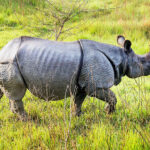
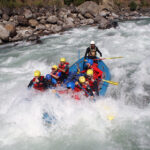
Bardia National Park covers 968 square kilometres of sal forest, riverine grassland, and floodplain along the Karnali and Babai rivers in the far western Terai. It is Nepal’s largest national park and home to the highest density of Bengal tigers in the country — as well as one-horned rhinoceros, wild elephant, sloth bear, gharial crocodile, and over 400 bird species. The Karnali River that runs along the park’s northern boundary is one of the finest whitewater rivers in Asia, and multi-day rafting trips through the park’s core area are among the most adventurous wildlife experiences in Nepal. Unlike Chitwan, Bardia receives a fraction of the annual visitors — meaning the forest is quieter, the wildlife encounters more intimate, and the overall experience closer to genuine wilderness.
- Distance from Nepalgunj: 1.5 to 2 hours by road (approximately 100 km)
- Best time: October to March for wildlife | November to February for tiger sightings
- Key wildlife: Bengal tiger, one-horned rhino, wild elephant, gharial, Gangetic dolphin
- Top activities: Jeep safari, walking safari, canoe on the Babai River, Karnali rafting
- Entry: Bardia National Park entry permit required (USD 15 per person per day)
2. Rara Lake
Nepal’s largest and most remote lake — deep blue at 2,990 metres
Rara Lake in Mugu District is Nepal’s largest lake and one of the most beautiful natural environments in the entire country. Sitting at 2,990 metres above sea level inside Rara National Park, the lake stretches 5 kilometres long and 3 kilometres wide, its surface a deep sapphire blue that reflects the surrounding snow-capped peaks and pine forest. Because it requires an onward flight from Nepalgunj to Talcha Airport followed by a 2 to 3-hour walk, Rara sees very few visitors compared to its extraordinary beauty — making it one of Nepal’s most rewarding off-the-beaten-path destinations. The lake is surrounded by Himalayan forest of pine, juniper, and rhododendron, and the panoramic viewpoint of Chuchemara Hill at 4,087 metres above the lake gives one of the finest high-altitude perspectives available without technical climbing.
- From Nepalgunj: Onward flight to Talcha Airport (Mugu, ~50 min) then 2–3 hour walk.
- Best time: March to May (rhododendron bloom), September to November (clear skies).
- Highlights: Rara Lake circumambulation walk (13 km), Chuchemara Hill viewpoint (4,087 m), wildlife including red panda, Himalayan black bear, musk deer.
- Atmosphere: Almost no other tourists — one of Nepal’s most peaceful wilderness experiences.
- Permits: Rara National Park entry fee required.
3. Dolpo — Shey Phoksundo National Park
The high Tibetan plateau — the world’s largest restricted trekking area
Dolpo is one of the most remote and mystical regions in Nepal — a high-altitude Tibetan plateau that sits behind the Dhaulagiri massif, effectively sealed from the monsoon rain and the modern world in equal measure. The region was immortalized by Peter Matthiessen in his book The Snow Leopard and by the French film Himalaya. Shey Phoksundo National Park, which covers most of Lower Dolpo, protects one of Nepal’s most extraordinary landscapes: the turquoise waters of Phoksundo Lake at 3,640 metres, ancient Tibetan Buddhist monasteries, snow leopard territory, and the remote villages of the Dolpopa people who have maintained their Tibetan Buddhist culture for centuries. Upper Dolpo is one of the world’s most restricted trekking areas, requiring a special permit of USD 500 per 10 days. Lower Dolpo and Phoksundo Lake are accessible on a standard trekkers’ permit.
- From Nepalgunj: Onward flight to Juphal Airport (Dolpa, ~35 min) then trek to Phoksundo
- Best time: May to June and September to November (Upper Dolpo: June to September)
- Highlights: Phoksundo Lake (3,640 m turquoise glacial lake), Shey Gompa, snow leopard habitat
- Trekking: Lower Dolpo trek 10–14 days | Upper Dolpo circuit 21–28 days
- Note: Juphal flights are weather-dependent — always build 2–3 day flexibility into Dolpo plans
4. Humla and Simikot
The far west frontier — remote, raw, and extraordinary
Humla is Nepal’s most remote and least-visited district — a far-western mountain region bordering Tibet, accessible only by air (via Simikot Airport from Nepalgunj) or by a gruelling multi-day road journey. The region’s remoteness is its most powerful quality: the landscape is high, dry, and dramatic in the manner of the Tibetan plateau, the Karnali River gorge cuts through the terrain in a series of extraordinary canyon formations, and the ancient villages along the route to the Tibet border preserve Tibetan Buddhist traditions in a form that is even more intact than Mustang. Simikot is also the starting point for the overland and trekking route to Kailash Mansarovar — the sacred mountain lake in Tibet that is one of the most important pilgrimage destinations in the Hindu and Buddhist worlds.
- From Nepalgunj: Onward flight to Simikot (Humla, ~35 min)
- Best time: March to May and September to November
- Highlights: Karnali River gorge, Limi Valley, Tibetan border villages, Kailash Mansarovar route
- For: Serious trekkers, cultural and pilgrimage travellers, adventure travel groups
5. Banke National Park
Bardia’s less-visited neighbour — tigers and forest in the Terai
Established in 2010, Banke National Park borders Bardia National Park to the east and covers 550 square kilometres of similar sal forest and riverine landscape along the Babai River. As a newer park it receives far fewer visitors than Bardia — making wildlife sightings particularly intimate. Bengal tiger, leopard, sloth bear, wild dog, one-horned rhino, and over 250 bird species are resident. For travellers based in Nepalgunj who want a half-day or full-day wildlife experience without travelling as far as Bardia, Banke National Park is the closest jungle destination.
- Distance from Nepalgunj: Approximately 30 to 45 minutes by road
- Key wildlife: Bengal tiger, leopard, sloth bear, one-horned rhino, wild dog
- Best time: November to March
- Activities: Jeep safari, nature walks
Why Bardia? Because Nepal’s Best Wildlife Secret Won’t Stay Secret Forever
Most travelers visit Nepal for the mountains. Fewer make it to the western Terai. That’s precisely what makes Bardia National Park so extraordinary right now — it’s the last great undiscovered wildlife destination in South Asia, and it’s thriving.
Covering 968 square kilometers of pristine sal forest, open grassland, and riverine habitat along the Karnali River, Bardia is Nepal’s largest national park in the Terai. It receives a fraction of the visitors that Chitwan draws, which means the jungle here is wilder, quieter, and far more intimate. No convoy of jeeps jostling for position. No overhyped lodge zones. Just you, the forest, and some of the most impressive wildlife on the planet.
The Bengal Tiger — Nepal’s Greatest Wildlife Encounter
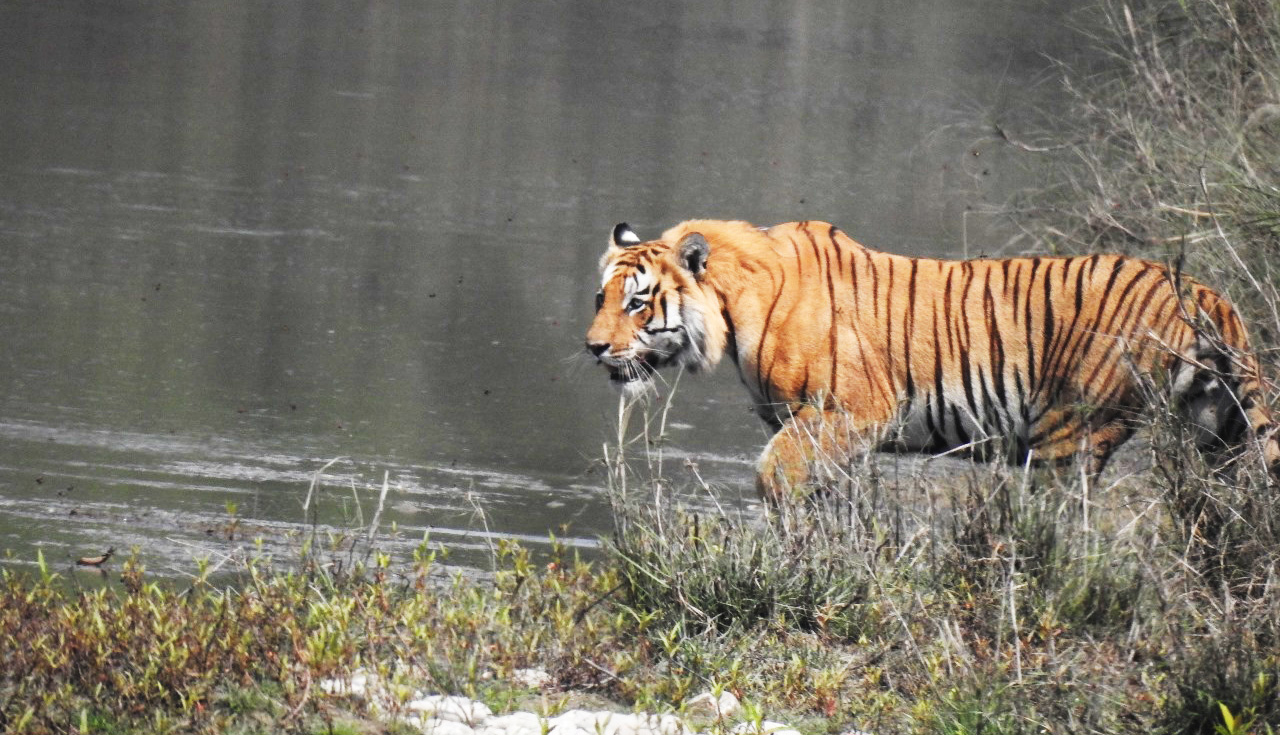
Bardia has emerged as Nepal’s top destination for Royal Bengal Tiger sightings, and the numbers back it up. The tiger population has grown sixfold — from fewer than 20 in 2009 to 125 by the last census in 2022. In Bardia’s open terrain of grasslands and waterholes, sightings are dramatically more likely than in the dense undergrowth of Chitwan. Our guests regularly encounter tigers on multi-day safaris, both on jeep drives and on foot with experienced naturalist guides.
One-horned rhinoceros, wild Asian elephants, leopards, swamp deer (barasingha), gharial crocodiles, mugger crocodiles, four-horned antelope, and Gangetic dolphins in the Karnali River round out a wildlife list that few parks anywhere can match. Over 400 bird species have been recorded here — including the critically endangered Bengal Florican, Sarus Crane, and Lesser Florican.
Walking Safaris — The Experience Africa Can’t Offer
One of Bardia’s most unique offerings is the guided jungle walk. Moving through a living tiger habitat on foot — tracking pugmarks in the soil, reading alarm calls from spotted deer, reading the jungle’s own language with a trained naturalist — is a level of safari experience that simply doesn’t exist in most of the world. Our guides include former wildlife trackers who have spent decades in this forest. They read it the way most people read a map.
The Karnali River — A Safari From the Water
A slow drift down the Karnali River on a raft is unlike any safari you’ve experienced. The river marks Bardia’s western boundary, and the sandy banks record every animal that has passed through. Tiger pugmarks, elephant craters, rhino tracks. From the water, you access a completely different perspective of the park — and a chance to spot Gangetic dolphins, crocodiles, and wildlife coming to drink at the riverside.
Tharu Culture — The Jungle’s Original Keepers
A Bardia visit isn’t complete without time with the indigenous Tharu community. These people have lived alongside the jungle for centuries, developing a deep, symbiotic relationship with the forest. Evening cultural programs, traditional meals, and village walks offer a genuine window into a way of life that has changed very little — and is all the more remarkable for it.
How to Book Your Ticket
Booking your Kathmandu–Nepalgunj or Nepalgunj–Kathmandu flight through Getaway Nepal Adventure is straightforward. Contact us via WhatsApp or email with your travel dates, number of passengers, and preferred departure time and we will confirm seat availability, issue the ticket, and send your itinerary confirmation same time.
Booking Information
✓ Contact us by email, phone, or WhatsApp with your travel date and number of passengers
✓ We confirm availability on your preferred departure time (morning or afternoon)
✓ Payment accepted by bank transfer, card payment, or cash in Kathmandu
✓ E-ticket issued and sent within 24 hours of payment confirmation
✓ Airport transfer in Nepalgunj can be arranged on request (to Bardia, Sauraha, or city hotels)
Important Notes
- All prices are in US Dollars per person one way, inclusive of taxes and airport fees.
- Ticket prices are subject to availability and airline confirmation — early booking is recommended especially for October to November and February to April travel.
- Nepalgunj to Kathmandu evening flights are available (Nepalgunj is night-operations equipped) — ideal for travellers returning from Bardia or arriving from onward destinations.
- Onward flights from Nepalgunj to Juphal, Talcha, Simikot, and Jumla are weather-dependent and subject to cancellation — always build flexibility into itineraries for these routes.
- Nepalgunj airport is located 8 km north of Nepalgunj city — allow 20 to 30 minutes for the airport transfer.
- For group bookings of 5 or more passengers, contact us for group fare pricing.
Recent Posts