Golfing Tour in Nepal
There are golf courses on every continent and in almost every country on earth. A small number of them are genuinely extraordinary. Fewer still are genuinely unforgettable. And only one country on earth puts golf courses inside a Himalayan river canyon with the highest mountains in the world visible above the rim.
Nepal is not a country that most golfers think of when planning a golf holiday. It should be. The Himalayan Golf Course in Pokhara is one of the most dramatic and talked-about layouts anywhere in Asia — a 6,900-yard, par-73 design built inside a deep river canyon by Major Ram Gurung, a retired British Gurkha officer, that has been praised by golf course architects and golf journalists from around the world for the sheer audacity and beauty of its setting. The Gokarna Forest Golf Resort outside Kathmandu, designed by the Gleneagles Golf Development team from Scotland, is one of South Asia’s finest tournament-standard 18-hole courses, set in ancient protected forest where spotted deer, barking deer, and monkeys wander freely across the fairways. The Royal Nepal Golf Club, one of Asia’s oldest golf clubs, sits directly across the road from Kathmandu International Airport and offers 18 holes of character-laden parkland golf played in the shadow of the Himalayan chain, on land that borders the sacred Hindu temple of Pashupatinath.
The Himalayan Golf Tour brings all of this together in a single, privately guided journey that combines rounds on Nepal’s finest courses with the country’s extraordinary cultural heritage, wildlife, and mountain scenery. This is not a golf trip with some sightseeing tacked on as filler. It is a complete Nepal experience built around golf as the primary activity, with everything else — the Kathmandu temples, the Pokhara lakeside, the Annapurna views — adding depth and context to a journey that no other golf destination on earth can replicate.
You will hit shots here that you will describe for the rest of your life. Not because you played well. Because of where you were standing when you played them.
Why Nepal for Golf?
Nepal occupies a unique position in global golf for several reasons that no marketing description fully captures. Understanding them helps explain why golfers who come here rarely describe it as just another golf trip.
The Setting is Genuinely Unlike Anything Else
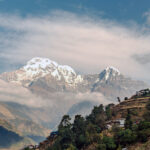
Golf is played in beautiful places around the world. Links courses on the Atlantic coast of Ireland. Parkland courses in the Scottish Highlands. Desert courses in the American Southwest. But Nepal puts golf inside a geography that no other golf destination has access to: the southern approaches of the world’s highest mountain range, where the landscape drops from 8,000-metre peaks to subtropical canyon within a vertical distance that no other country compresses so dramatically. When you stand on the first tee at Gokarna Forest Golf Resort and see the snowcapped Himalayan chain above the treeline of an ancient forest, you are not in a scenic golf destination. You are in a genuinely different category of experience.
The Courses Are Genuinely Interesting
None of Nepal’s courses are perfect by the standards of Augusta or St Andrews. What they have instead is character, challenge, and a quality of originality that manicured resort courses rarely possess. The Himalayan Golf Course is regularly cited by visiting golf writers as one of the most unexpectedly thrilling rounds they have played anywhere. The Gokarna Forest course, designed to tournament standard, offers a genuinely challenging 18-hole test. Royal Nepal Golf Club, with its proximity to Pashupatinath Temple and its historic connection to Nepal’s Rana aristocracy, offers golf on genuinely sacred ground. These are not courses that will disappoint golfers looking for exceptional quality combined with extraordinary surroundings.
Nepal Has the World’s Highest Pro-Per-Golfer Ratio
Only around 700 people in Nepal play golf regularly. One in ten of them is a professional. Nepal therefore has the highest concentration of professional golfers per active player of any country on earth. The caddies and staff at Nepal’s courses are knowledgeable, friendly, and bring the same warmth and care to the golf course that Nepal’s broader tourism culture is famous for. Caddies at the Royal Nepal Golf Club and Gokarna Forest Resort are familiar with every contour and idiosyncrasy of their courses and provide genuine assistance rather than the passive bag-carrying that caddies at busy resort courses often default to.
Golf Plus Nepal — The Cultural Dividend
No other golf destination combines competitive courses with this density of extraordinary non-golf experiences. The Kathmandu Valley’s seven UNESCO World Heritage Sites are 30 to 45 minutes from the Gokarna Forest Golf Resort. The Pokhara lakeside, the Annapurna paragliding, and the pre-dawn mountain panorama from Sarangkot are all within reach of the Himalayan Golf Course. The heritage, the spirituality, the wildlife, and the mountain scenery of Nepal do not compete with the golf — they complete it, giving the trip a depth and variety that a pure golf destination like Marbella or Scottsdale cannot offer.
Nepal’s Golf Courses
Nepal currently has five golf courses available to visiting international golfers. The Himalayan Golf Tour is centred on the four courses that together offer the most complete and varied golf experience: two in Kathmandu and two in Pokhara.
Royal Nepal Golf Club
Kathmandu | Til Ganga, directly opposite Tribhuvan International Airport | 18 holes (9-hole layout played twice with different tees and flags) | Par 67 | 5,410 yards
Nepal’s oldest golf club, founded in 1917 as the Gauchar Golf Club and granted the title Royal in 1965 by His Majesty King Mahendra. It is one of the oldest golf clubs in Asia and the starting point for any serious Nepal golf itinerary. The course is a tree-lined parkland design with a stream cutting through several holes. At par 67 over 5,410 yards it is not long by modern standards, but the unique character of the course makes up for what it lacks in distance. The 5th and 6th holes run through the grounds of the sacred Pashupatinath Temple complex, meaning golfers play on genuinely holy land, sometimes under the gaze of orange-robed Hindu sadhus meditating in the adjacent temple grounds. On Wednesday and Sunday mornings a group of retired Gurkha officers in their 70s and 80s tees off at 7:30 AM sharp — their perfect posture, disciplined play, and deep knowledge of the course make for an extraordinary gallery to play behind. The driving range shares space with the 9th fairway, and the elevated 9th tee sends drives over the 7th and 8th greens in a layout that perfectly reflects the organised, characterful charm of Kathmandu itself.
Gokarna Forest Golf Resort
Kathmandu | Gokarna Forest Reserve, northeastern valley rim | 18 holes | Par 72 | 6,777 yards
The finest tournament-standard golf course in Nepal, designed by Gleneagles Golf Development of Scotland and set within an ancient protected forest reserve on the northeastern rim of the Kathmandu Valley. The course opened in 2001 and is the most technically demanding layout in Nepal, with the Himalayan chain visible above the treeline from multiple elevated tee positions. The forest setting is extraordinary: ancient sal trees frame the fairways, and spotted deer, barking deer, and langur monkeys wander the rough with complete indifference to the golf. The course plays at 6,777 yards from the back tees and features challenging fairway undulation, well-protected greens, and several holes where the correct line off the tee is critical. The adjacent Gokarna Forest Resort includes a four-star hotel and the Harmony Spa, making it the most complete golf resort facility in Nepal. The proximity to Boudhanath Stupa and Pashupatinath Temple (both within 20 minutes by vehicle) means a morning round of golf can be followed by an afternoon at two of Nepal’s most important heritage sites.
Himalayan Golf Course
Pokhara | Bijayapur River canyon, 6 km east of Pokhara city | 18 holes | Par 73 | 6,900 yards
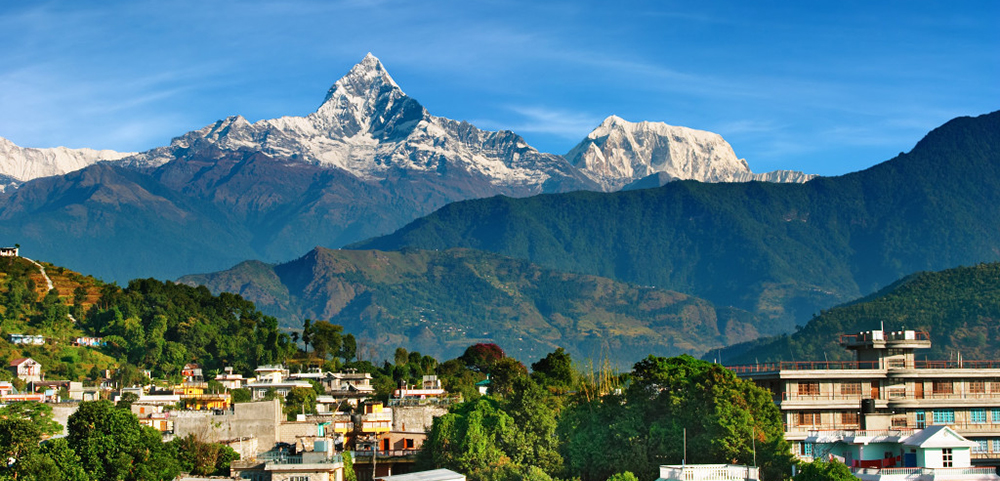
The most dramatic golf course in Asia and one of the most talked-about layouts in the world for the sheer audacity of its setting. The Himalayan Golf Course was designed by Major Ram Gurung, a retired British Army Gurkha officer, who in 1994 looked down into the steep river canyon of the Bijayapur River on the eastern edge of Pokhara and saw a golf course where everyone else saw an impassable gorge. What he built is a 6,900-yard, par-73 layout that plays in, over, and through the canyon with Annapurna II (7,937 m) and the full Annapurna range visible above the canyon rim from multiple tee positions. Holes are named after local wildlife and Himalayan features: ‘Leopard’s Lair,’ ‘Eagle’s Nest,’ ‘River Rock.’ The 12th hole requires a pitch across the Bijayapur River to a small, tightly defended green that is one of the most photogenic shots in Asian golf. Elevated tees send drives 300 feet down into the canyon below. Several holes cross the river via wooden bridges. The conditions are firm and naturally maintained — sheep and cattle contribute to the rough management in a way that no club secretary in Surrey or Connecticut would countenance, but that gives the course an authenticity entirely in keeping with Nepal. Famous golf course architect Tom Doak wrote high praise in the course guestbook after his 2012 visit. LINKS Magazine called it ‘one of those fantasy courses you see on calendars, except you are actually playing it.’ Come with enough golf balls and a sense of adventure. The starter’s first question is how many balls you brought.
Yeti’s Golf Course at Fulbari Resort and Spa
Pokhara | Fulbari Resort, Pokhara Valley | 9 holes (expanding to 18) | Par 36 | 3,200 yards
The Fulbari Resort’s golf course sits within the resort’s extensive grounds on the banks of the Seti River with the Annapurna range visible to the north. The course is shorter and less technically demanding than the Himalayan Golf Course and suits golfers who want a relaxed afternoon round combined with the resort’s spa and pool facilities. American golf course architect Ron Fream, who has visited Nepal more than 20 times and has provided counsel to both Pokhara courses, describes the setting as one of the most beautiful resort golf settings in Asia. The adjacent Fulbari Resort and Spa is one of Pokhara’s finest properties, making it an ideal combination for an afternoon round followed by an Annapurna-view spa treatment.
Also Worth Noting: Nirvana Country Club, Dharan
The Nirvana Country Club in Dharan in eastern Nepal offers a private club experience in the foothills of the Kanchenjunga range for golfers who want to extend their Nepal golf itinerary into the far east of the country. It is included in extended Nepal golf itineraries for those with 12 or more days available and a desire to play in all three of Nepal’s main golf regions.
The Himalayan Golf Tour — 8 Days
The standard Himalayan Golf Tour is eight days, covering Kathmandu and Pokhara with rounds on all four main courses combined with private cultural sightseeing and the full Nepal experience. The itinerary below is the most popular starting point. Every element can be adjusted.
Itinerary at a Glance
Day 01 Arrive Kathmandu — welcome, hotel check-in, Boudhanath evening walk (overnight: Kathmandu)
Day 02 Kathmandu cultural sightseeing — Pashupatinath, Bhaktapur, Patan Museum (overnight: Kathmandu)
Day 03 Golf Day 1 — Royal Nepal Golf Club (18 holes), afternoon at Gokarna Forest (overnight: Kathmandu)
Day 04 Golf Day 2 — Gokarna Forest Golf Resort (18 holes), Boudhanath afternoon (overnight: Kathmandu)
Day 05 Fly to Pokhara — Sarangkot sunrise, Phewa Lake afternoon, caddie briefing (overnight: Pokhara)
Day 06 Golf Day 3 — Himalayan Golf Course (18 holes), Bijayapur canyon round (overnight: Pokhara)
Day 07 Golf Day 4 — Yeti’s Golf Course / Fulbari morning round, Pokhara afternoon at leisure (overnight: Pokhara)
Day 08 Fly to Kathmandu — optional Himalayan scenic flight, departure (overnight: Departure)
Day-by-Day Detail
Day 1 — Arrival in Kathmandu
Your private representative meets you at Tribhuvan International Airport with a private vehicle and transfers you to your hotel. The recommended base in Kathmandu is the Gokarna Forest Resort, which places you on the doorstep of the Gokarna course for morning tee times without any transfer and gives access to the forest trails for an evening walk. Dwarika’s Hotel is the alternative for those who prioritise the finest cultural heritage hotel experience. After check-in, the evening at Boudhanath Stupa at dusk is the traditional introduction to Nepal: the great circular circumambulation walk as the monastery windows light up and the butter lamps are placed around the plinth.
Day 2 — Kathmandu Cultural Sightseeing
The day before the first round is deliberately cultural rather than golf-focused. Understanding the context of the city where you are playing makes the golf experience richer. Your private guide covers Pashupatinath Temple in the morning — including the explanation that the 5th and 6th holes of the Royal Nepal Golf Club run through this temple’s grounds, so you will literally be playing golf on holy land tomorrow. Bhaktapur’s medieval streets in the afternoon and the Patan Museum provide the architectural and artistic context. By the time you reach the first tee the following morning you will understand something of where you are in the world.
Day 3 — Golf at Royal Nepal Golf Club
The morning tee time at the Royal Nepal Golf Club is arranged for 7:30 AM to catch the best light and the cooler morning temperatures before Kathmandu’s midday heat builds. The recommended approach is to play the 9-hole layout twice — once in each direction, with different tees and flags for the second nine, as is the traditional format at RNGC. Your caddie knows every slope and every local rule. Watch for the sadhus on the 5th and 6th holes — their indifference to your scorecard is complete, and their presence is part of what makes golf here genuinely different. After the round, the Gokarna Forest Resort’s golf club facilities provide the 19th hole setting: a cold Everest beer with the Himalayan chain visible above the ancient forest.
Day 4 — Golf at Gokarna Forest Golf Resort
The full 18-hole Gokarna Forest course demands more respect than the Royal Nepal. The Scottish-designed layout at par 72 over 6,777 yards from the back tees is the most technically demanding course in Nepal, with fairway bunkering, well-protected greens, and the kind of course architecture that rewards course management over power. The ancient sal forest frames every hole and the wildlife encounters are frequent: spotted deer crossing the 7th fairway is a common enough occurrence that experienced caddies pause without comment until the deer pass. The afternoon after the round is free for Boudhanath — the stupa is 20 minutes from Gokarna — or for the forest trails within the resort’s wildlife sanctuary.
Day 5 — Fly to Pokhara, First Sight of the Annapurna Range
The 25-minute domestic flight from Kathmandu to Pokhara is one of Nepal’s finest aerial transitions. As the aircraft banks west the Annapurna massif fills the entire northern horizon. The landing at Pokhara airport brings you within visual range of the mountains that frame the Himalayan Golf Course. From the airport the private vehicle takes you to your Pokhara hotel — the Temple Tree Resort on the lakeside or the Pavilions Himalayas for those who want the most private and elevated accommodation in the region. The Sarangkot sunrise the following morning requires a 5:00 AM departure, so the caddie briefing for the afternoon and the course reconnaissance drive to the Himalayan Golf Course canyon rim are arranged before the evening lakeside dinner.
Day 6 — Golf at the Himalayan Golf Course
This is the day that most golfers on the Himalayan Golf Tour describe as the finest golf experience of their lives. Not because the course is perfect — it is not, in any conventional sense. Because of the combination of the canyon, the river, the mountain backdrop, and the sheer improbability of golf being played here at all. Tee off at 7:30 AM before the canyon heats up. The first hole sends you down from the clubhouse plateau toward the canyon rim. The second tee is on a cliff ledge. From here the experience is unlike anything in golf: drives over the Bijayapur River, approach shots from canyon walls, the 12th hole pitch across the river to the small green with the water running below. Your caddie has played these holes hundreds of times and knows exactly which local hazards — the fences around the greens to keep off the cattle, the firm canyon fairways, the unpredictable bounces off the sun-hardened turf — are part of the character rather than the maintenance. After 18 holes the clubhouse bar, with Annapurna visible above the canyon rim, is exactly the right place to be.
Day 7 — Yeti’s Golf Course and Pokhara at Leisure
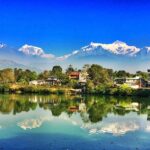
Day 7 is deliberately lighter in pace. A morning round at Yeti’s Golf Course at the Fulbari Resort gives a more relaxed nine-hole experience with the Annapurna range above the resort grounds. The afternoon is entirely unscheduled: Phewa Lake by rowboat, the World Peace Pagoda forest walk, a Pokhara lakeside lunch at a restaurant with the mountains reflected in the water, or a spa session at the Fulbari Resort or Temple Tree. Some golfers on this tour take the optional Annapurna helicopter sunrise on day 7 morning — the helicopter departs Pokhara airport at dawn and lands at altitude in the Annapurna foothills, returning with the morning thermals rising below you — and then play a leisurely afternoon round at Yeti’s. The evening in Pokhara is the tour’s final relaxed dinner before the Kathmandu return.
Day 8 — Return to Kathmandu, Departure
The morning Pokhara to Kathmandu flight takes 25 minutes and arrives in time for an optional Himalayan scenic mountain flight from Kathmandu’s domestic terminal for those who want to see Everest from the air before departure. The one-hour panoramic flight covers the full eastern Himalayan chain from 6,700 metres. The private vehicle then transfers you to Tribhuvan International Airport for your international departure. Your trip coordinator handles all transfer timing.
Accommodation
Kathmandu — Gokarna Forest Resort (Golf Package) or Dwarika’s Hotel
The Gokarna Forest Resort is the natural accommodation choice for the Kathmandu golf days, combining immediate access to the Gokarna Forest Golf Resort with a four-star hotel and spa set within the same forest reserve. The property includes a swimming pool, the Harmony Spa, and a restaurant with Himalayan views. It is also adjacent to the ancient Gokarna Mahadev Temple and the Boudhanath area. For golfers who prioritise cultural heritage accommodation alongside their game, Dwarika’s Hotel in the city is the alternative, with a 20-minute transfer to both Kathmandu courses.
Pokhara — Temple Tree Resort or Pavilions Himalayas
The Temple Tree Resort on the Pokhara Lakeside is the most popular choice for the golf days: well-located for the drive to the Himalayan Golf Course, with a beautiful garden property, lakeside access, and mountain views from the pool terrace. The Pavilions Himalayas, 20 minutes from Lakeside, offers private pool villas with the most exclusive and quiet setting in the Pokhara region, with the Annapurna range visible from every villa terrace.
What is Included
Included
- All green fees and caddie fees on four courses: Royal Nepal Golf Club (18 holes), Gokarna Forest Golf Resort (18 holes), Himalayan Golf Course (18 holes), Yeti’s Golf Course (9 holes)
- Private expert guide for all cultural sightseeing days
- Private luxury vehicle with driver for all ground transfers
- All domestic flights: Kathmandu to Pokhara and Pokhara to Kathmandu
- 7 nights accommodation in 4 to 5-star properties as specified
- Daily breakfast and selected meals
- All cultural entry fees, heritage site permits, and national park fees
- Airport meet-and-greet on arrival and departure transfer
- 24-hour on-trip support contact throughout your stay
Optional Additions
- Extra rounds at any course on rest days — green fees arranged on request
- Himalayan scenic mountain flight over Everest from Kathmandu (USD 180 to USD 220 per person)
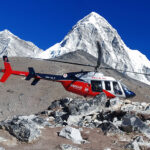
- Annapurna helicopter sunrise from Pokhara — champagne breakfast at altitude
- Chitwan National Park wildlife safari extension (2 to 3 days)
- Extended Golfing Nepal tour including Nirvana Country Club, Dharan (add 3 days)
- Professional golf coaching session with a Nepali pro at Gokarna Forest Resort
- Spa treatments at Gokarna’s Harmony Spa or Fulbari Resort
Not Included
- International flights to and from Kathmandu
- Nepal Tourist Visa (USD 50 per person for 30 days, available on arrival or e-Visa online)
- Personal expenses: golf equipment rental beyond caddies, beverages, tips, laundry
- Travel insurance (strongly recommended, including medical evacuation coverage)
Practical Information for Golf in Nepal
Golf Equipment and Hire
Golf equipment hire is available at Gokarna Forest Golf Resort and the Himalayan Golf Course at reasonable daily rates. Gokarna carries a selection of rental clubs suitable for all handicaps. The Himalayan Golf Course’s rental equipment is more limited — serious golfers are recommended to bring their own clubs or hire from Gokarna and transport them to Pokhara. Club transportation on domestic flights is straightforward and involves no surcharge beyond the standard domestic luggage allowance. Golf shoes with soft spikes are recommended throughout. No metal spikes on any Nepal course.
Caddies
Caddies are mandatory at the Himalayan Golf Course (essential for navigation in the canyon — you will not find your ball without a local caddie’s knowledge of the terrain) and strongly recommended at all other courses. Caddie fees are modest by international standards: approximately USD 5 to USD 10 per round at Royal Nepal and Gokarna, USD 8 to USD 15 at the Himalayan Golf Course. Tips are customary and appreciated — the equivalent of a round fee per caddie is a reasonable benchmark for an excellent caddie. The caddies at Nepal’s courses are friendly, knowledgeable, and genuinely invested in your enjoyment of the round.
Best Playing Season
- October and November are the finest months for golf in Nepal. Post-monsoon conditions give firm, fast fairways, clear mountain views, and comfortable playing temperatures (18 to 24 degrees Celsius during the day, cool evenings). The Himalayan Golf Course canyon is particularly beautiful in autumn with clear Annapurna views from every elevated tee position.
- December through February is excellent for winter golf. Temperatures are comfortable for playing (15 to 20 degrees Celsius) though evenings are cold. The mountain views are often at their clearest in January. The Gokarna Forest course has the best winter turf conditions of any Nepal course.
- March and April are good spring months with building mountain visibility and comfortable temperatures. The rhododendron bloom in the surrounding hills of Pokhara is spectacular from the Himalayan Golf Course rim.
- May and September are transitional months with variable conditions. Playable but not at their best.
- June through August is the monsoon season. Golf in Nepal is playable during monsoon but the fairways are soft, the canyon at the Himalayan Golf Course sees significant rainfall, and the mountain views are frequently obscured by cloud. Not the recommended season for a dedicated golf tour.
Altitude and Playing Conditions
Nepal’s golf courses sit between 820 and 1,400 metres above sea level. This altitude is not high enough to cause altitude sickness but is high enough to affect ball flight: at 1,400 metres (Kathmandu), the ball travels approximately 5 to 7 percent further than at sea level due to the reduced air density. At Pokhara’s 820 metres the effect is slightly less but still present. Golfers with calibrated distances should expect longer carry than usual and adjust their club selection accordingly — particularly on downwind holes and off elevated tees. The effect is a pleasant discovery on day one when drives land noticeably further than expected.
Dress Code and Course Etiquette
- Smart casual golf wear is appropriate at all Nepal courses. No specific dress code is enforced but standard golf attire (collared shirt, golf trousers or shorts, golf shoes) is expected at Gokarna and the Himalayan Golf Course. Royal Nepal Golf Club has a more relaxed dress standard.
- The Himalayan Golf Course has fences around several greens to keep cattle off the putting surfaces. These are part of the course design and rules — local rules apply when your ball is near or beyond a fence. Your caddie will explain the local rules specific to each hole.
- At the Royal Nepal Golf Club, respect for the adjacent Pashupatinath Temple grounds is essential. Photography toward the temple complex from the 5th and 6th holes is generally acceptable but should be done with discretion. Do not enter the temple grounds during your round.
- Tipping caddies generously is a fundamental part of golf etiquette in Nepal and directly supports the families of the caddies who depend on the work. Nepal’s golf economy is small and the caddies’ income is directly connected to the quality of the experience they provide.
Combining Golf with Trekking
Many golfers on the Himalayan Golf Tour add a short Annapurna foothills trek to their Pokhara days. The Australian Camp circuit from Kande (two to three hours walking, no permits required, maximum altitude 2,060 meters) is the ideal addition for golfers who want a morning on the mountain trails before an afternoon round. The Sarangkot sunrise walk (one hour uphill) is a standard pre-dawn activity that most golfers on the tour do on the morning before or after the Himalayan Golf Course round. Neither activity affects golf fitness negatively at this altitude.
Begin Your Himalayan Golf Journey
The Himalayan Golf Tour is one of the most genuinely original golf holidays available anywhere in the world. Not because Nepal has the finest courses in Asia by conventional measures — it does not. But because Nepal offers something that no other golf destination has: a combination of adventurous, character-laden, genuinely surprising golf set against the most spectacular mountain backdrop on earth, combined with a cultural and spiritual depth that makes every non-golf hour as memorable as every golf hour.
Golfers who come to Nepal expecting a standard international golf trip leave having experienced something fundamentally different from any round they have played before. The canyon at Pokhara. The sadhus on the Kathmandu fairways. The snow on the Annapurna range above the greens. The caddie who has played this course every day for twenty years and knows exactly what you need to know on every hole. These are not golf experiences. They are Nepal experiences that happen to involve golf.
To plan your Himalayan Golf Tour, contact us with your travel dates, your handicap level, and any preferences about course order or additional activities. We will build the itinerary around you.
Recent Posts